What is Topical Authority in SEO and GEO? [2026 Complete Guide]
Learn what topical authority is and how to build it. Complete 2026 guide for startups showing step-by-step how to dominate your niche through strategic topic coverage.
Topical Authority in SEO: The Complete 2026 Guide to Niche Dominance
Topical Authority in SEO: The Complete 2026 Guide to Niche Dominance
What is Topical Authority in SEO? [2026 Complete Guide]
Introduction
You publish 50 high-quality articles about different topics. Your competitor publishes 50 articles all about one topic. Who ranks better?
The competitor wins. Every time.
This is topical authority in action. Google doesn't just want good content anymore. It wants proof that you're an actual expert on a subject. Not someone who writes one article about project management, one about email marketing, and one about social media. But someone who covers project management so thoroughly that Google has no choice but to see you as the authority.
For startups and small marketing teams, this changes everything. You can't outspend enterprise competitors on content volume. But you can become more authoritative than them on a specific niche. A B2B SaaS with 20 employees can outrank HubSpot for "remote team project management" by building deeper topical authority in that specific area.
This guide explains what topical authority is, why it matters more in 2026 than traditional domain authority metrics, and exactly how to build it with limited resources. You'll learn the strategy major SEO tools won't teach you: how to dominate a niche through systematic topic coverage rather than chasing individual keywords.
If you're tired of creating great content that doesn't rank, topical authority is your answer.
What is Topical Authority?
Topical authority is Google's measure of how comprehensively and credibly your website covers a specific subject.
Think of it this way: if someone asks Google "Who knows the most about email marketing automation?" which site should it trust? The one with a single in-depth guide, or the one with 30 articles covering every aspect of email automation, integration patterns, deliverability, list segmentation, and campaign optimization?
The second site demonstrates topical authority. It doesn't just understand email marketing automation. It covers the entire topic ecosystem.
Technical definition: Topical authority reflects how well Google's algorithm perceives your site as a reliable, comprehensive source for information within a defined subject area. It's built through content depth, breadth, interconnection, and external validation.
How It Works in Google's Algorithm
Google uses semantic analysis and entity recognition to understand topics and subtopics. When you publish content about "content marketing," Google maps that to a knowledge graph containing related concepts: SEO, blog strategy, content distribution, content calendars, and dozens of others.
Sites that cover multiple related concepts within the topic cluster signal expertise. Google sees the connections. A site with articles on content strategy, content distribution, content measurement, and content team management shows deeper understanding than a site with one generic "content marketing guide."
The algorithm evaluates:
Topic coverage breadth: How many subtopics within the main topic do you address?
Topic coverage depth: How thoroughly do you explain each subtopic?
Internal linking structure: How well do you connect related concepts?
Content recency: How current is your information?
External validation: Do authoritative sites in the topic area link to you?
User engagement: Do people stay on your site and explore multiple related articles?
Topical Authority vs Domain Authority
Domain Authority (DA) is a metric created by Moz to predict how well a domain might rank overall. It's based primarily on backlink quantity and quality.
Topical authority is different:
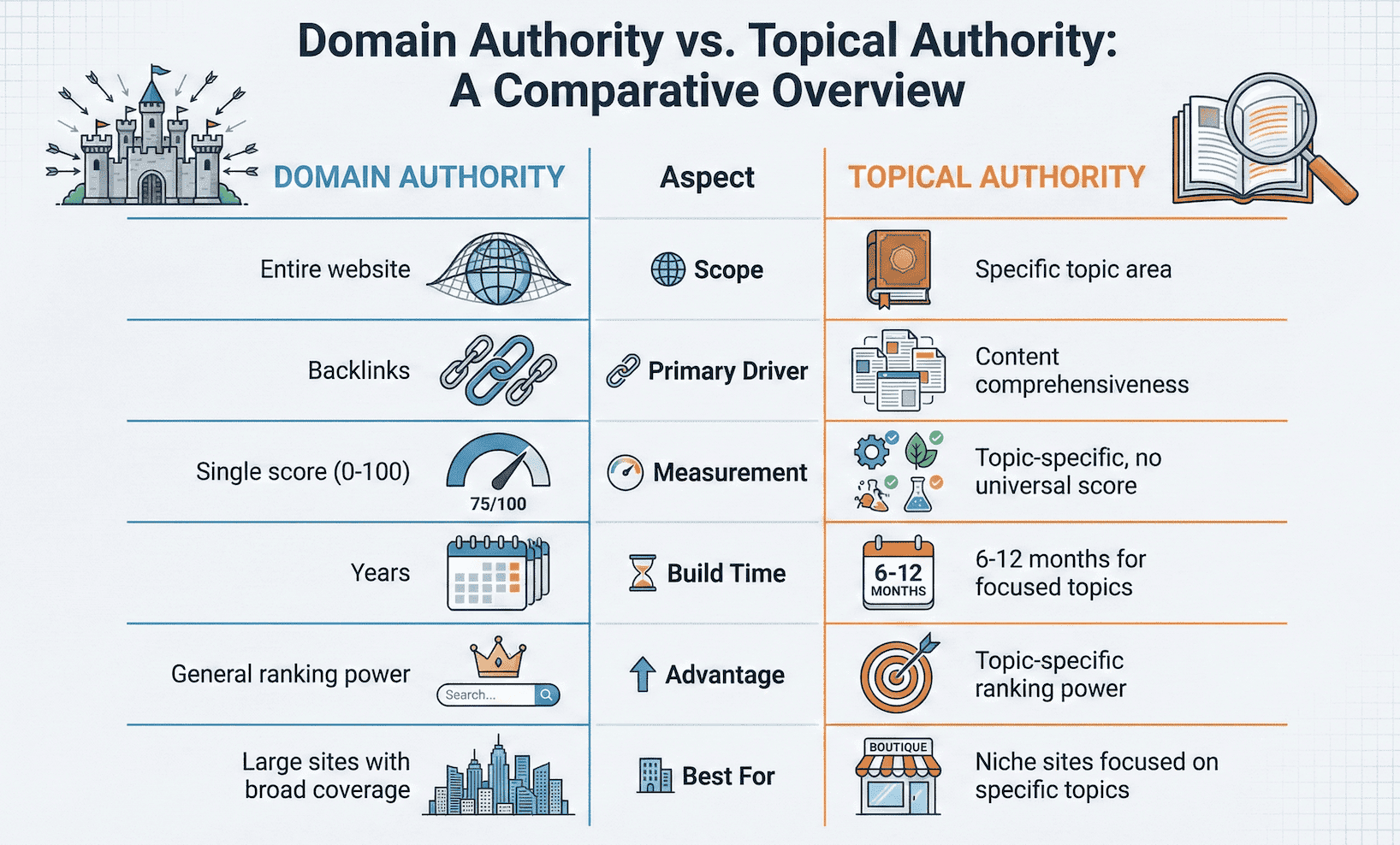
Domain Authority vs Topical Authority A Comparative Overview
You can have low domain authority but high topical authority. A new blog focused entirely on "remote work productivity tools" can outrank Forbes for queries in that niche, despite Forbes having far higher DA. Forbes covers thousands of topics. The focused blog covers one topic comprehensively.
For startups and small teams, topical authority is the more achievable and more valuable metric.
Why It Matters More in 2026
Several algorithmic and behavioral shifts make topical authority crucial:
1. Google's shift to entity-based search The algorithm understands topics as connected entities, not isolated keywords. It rewards sites that demonstrate understanding of these connections.
2. AI Overview prominence Google's AI Overviews preferentially cite sources with demonstrated topical expertise. Comprehensive coverage gets cited more often than scattered individual articles.
3. Search intent sophistication Users search with more specific, nuanced queries. "Best CRM" gets millions of searches. But the real traffic comes from hundreds of specific queries like "CRM with custom fields for real estate" or "affordable CRM for B2B SaaS startups." Sites with topical authority rank for all these long-tail variations.
4. E-E-A-T emphasis Google's Expertise, Experience, Authority, and Trustworthiness (E-E-A-T) guidelines reward demonstrated expertise. Topical authority is how you demonstrate expertise at scale.
5. Reduced effectiveness of isolated content Publishing one great article about a topic and moving on doesn't work anymore. Google wants to see sustained expertise.
The 5 Pillars of Building Topical Authority
Building topical authority isn't mysterious. It follows a systematic approach across five pillars.
Pillar 1: Topic Selection and Scope Definition
The biggest mistake: choosing too broad a topic.
"Marketing" is too broad. Even "content marketing" is too broad for a new site. But "SaaS content marketing for early-stage B2B companies" is specific enough to dominate.
How to choose your topic:
Start with business relevance. Your topic should directly relate to your product, service, or expertise. Don't build topical authority in "dog training" if you sell project management software. Build it in "project management for remote teams" or "agile methodology for startups."
Evaluate competition realistically. Use Ahrefs or Semrush to see who currently ranks for your target topic. If the top 10 results are all from sites with 80+ domain authority and thousands of articles, narrow your scope.
Check topic breadth. Can you brainstorm 50-100 subtopics within your chosen topic? If yes, it's broad enough. If you struggle to find 20 subtopics, it might be too narrow (or you need deeper topic research).
Validate search demand. Use keyword research tools to verify people actually search for content in this topic area. Zero search volume across all subtopics means topical authority won't drive traffic.
Example of good topic scoping:
Too broad: "Productivity"
Still too broad: "Team productivity"
Better: "Remote team productivity"
Best: "Async productivity for distributed software teams"
The narrower scope lets you cover every angle comprehensively. You can always expand later.
Pillar 2: Comprehensive Topic Mapping
You need a content roadmap that covers the entire topic landscape.
Create a topical map (content cluster strategy):
Step 1: Identify your pillar content This is your comprehensive, authoritative guide to the main topic. For "remote team productivity," this might be a 5,000-word guide covering fundamentals, challenges, strategies, and tools.
Step 2: Map subtopics Break the main topic into logical subtopics. Use:
Keyword research tools (enter your main topic, explore "Questions" and "Related" sections)
Google's "People Also Ask" boxes
Competitor content analysis (what subtopics do top-ranking sites cover?)
Customer questions (what does your audience actually ask?)
For "remote team productivity," subtopics might include:
Async communication
Time zone management
Productivity tools
Meeting efficiency
Work-life balance for remote workers
Onboarding remote employees
Remote team culture
Measuring remote productivity
Step 3: Identify supporting cluster content Each subtopic becomes a cluster of related articles. "Async communication" might include:
What is asynchronous communication?
Best async communication tools
How to implement async communication
Async communication best practices
Async vs sync communication comparison
Step 4: Map content tiers Organize content into tiers:
Tier 1 (Pillar): 1-3 comprehensive topic guides (3,000-6,000 words)
Tier 2 (Subtopics): 8-15 detailed subtopic guides (1,500-2,500 words)
Tier 3 (Supporting): 30-60 specific, focused articles (800-1,500 words)
This structure shows Google comprehensive coverage while remaining manageable for small teams.
Pillar 3: Systematic Content Creation
Quality beats quantity, but you need both quality and sufficient quantity to establish authority.
Content creation strategy:
Focus on depth first, breadth second. Start with your pillar content and top-tier subtopics. Publish 10-15 exceptional pieces before expanding to tier 3 supporting content. It's better to have 10 comprehensive articles than 50 thin ones.
Maintain consistent expertise signals:
Name specific authors with relevant credentials
Include data, statistics, and research
Provide unique insights from experience
Update regularly with fresh information
Use question-focused formats: Many queries around your topic will be questions. Create content that directly answers them:
"How do I...?"
"What is the best way to...?"
"Why does...?"
"When should I...?"
Interlink aggressively: Every article should link to related articles in your topic cluster. Your pillar content should link to all major subtopics. Subtopic articles should link to related subtopics and back to the pillar. This internal linking demonstrates topic coverage to Google.
Optimize for entities, not just keywords: Include related concepts, tools, methodologies, and people associated with your topic. For "remote team productivity," mention specific tools (Slack, Zoom, Asana), methodologies (async-first, time zone rotation), and thought leaders in the space.
Publication cadence:
Startups with 1 content person: 4-6 articles per month
Small teams (2-3 content people): 8-12 articles per month
Larger teams: 15+ articles per month
Consistency matters more than volume spikes. Publishing 4 quality articles monthly for 12 months beats publishing 30 articles in month 1 and nothing for the next six months.
Pillar 4: Strategic Internal Linking
Internal linking is how you show Google your topic expertise. Without it, you have isolated articles. With it, you have a comprehensive knowledge base.
Hub-and-spoke model:
Your pillar content is the hub. Subtopic articles are spokes. Create clear links:
Pillar links to all subtopics
Subtopics link back to the pillar
Subtopics link to related subtopics
Supporting articles link up to their subtopic parent
Use descriptive anchor text: Don't use "click here" or "this article." Use descriptive text that includes the target topic: "our comprehensive guide to async communication" or "strategies for time zone management."
Link depth matters: No article should be more than 3 clicks from your homepage. Your pillar content should be 1-2 clicks maximum.
Update old content with links to new content: When you publish a new article about "time zone management best practices," go back to your pillar content and relevant subtopic articles and add links to the new piece.
Implement breadcrumbs: Help users and Google understand content hierarchy with breadcrumb navigation (Home > Remote Productivity > Async Communication > Tools).
Pillar 5: External Validation and Backlinks
Topical authority isn't just what you say about yourself. It's what others say about you.
Earn topical backlinks: Links from sites within your topic area carry more weight than random backlinks. A link from a respected remote work blog to your remote productivity content is worth more than a link from an unrelated site with higher DA.
Strategies for topical backlinks:
1. Create linkable assets in your topic
Original research and data
Comprehensive resource lists
Tools and calculators
Industry surveys
Visual resources (infographics, templates)
2. Guest post on topic-relevant sites Write for publications, blogs, and platforms in your niche. Include links back to your pillar and subtopic content.
3. Engage with topic communities Participate in forums, LinkedIn groups, Reddit communities, and Slack channels related to your topic. Provide genuine value. When appropriate, reference your content.
4. Build relationships with topic influencers Connect with people who write about or teach your topic. Share their content. Provide value. When you publish something exceptional, they're more likely to link to it.
5. Monitor brand and topic mentions Use tools like Google Alerts, Mention, or Ahrefs Alerts to track when people mention your topic. Reach out when they discuss your topic area but link to competitors. Suggest your resource if it's genuinely better.
Quality over quantity: 10 backlinks from highly relevant, topical sites beat 100 backlinks from random blogs.
How to Build Topical Authority: Step-by-Step Roadmap
Here's your practical implementation plan.
Month 1-2: Foundation
Week 1: Topic selection and competitive analysis
Define your specific topic scope
Analyze top 20 ranking sites for your main topic keyword
Document their content coverage (how many articles, what subtopics)
Identify gaps (subtopics they don't cover well)
Week 2-3: Content mapping
Brainstorm 50-100 potential subtopics
Organize into pillar > subtopic > supporting hierarchy
Prioritize based on search demand and strategic importance
Create content calendar for first 6 months
Week 4-8: Core content creation
Write and publish pillar content (your comprehensive guide)
Create 4-6 tier 2 subtopic articles
Implement internal linking structure
Set up breadcrumb navigation
Results after Month 2:
1 pillar article published
4-6 subtopic articles published
Clear topic focus established
Internal linking framework in place
Month 3-6: Expansion
Systematic content production:
Publish 4-6 new articles monthly
Focus on tier 2 subtopics first (complete 8-12 total)
Begin tier 3 supporting content
Update pillar content as you add new subtopics
Internal linking maintenance:
Add new articles to your topic cluster
Update existing articles to link to new content
Strengthen pillar-to-spoke connections
Begin external validation:
Create 1-2 linkable assets (original research, comprehensive resources)
Start guest posting on 2-3 topically relevant sites
Engage in topic communities
Results after Month 6:
15-25 published articles in your topic cluster
Comprehensive coverage of major subtopics
Beginning to rank for long-tail queries
Initial external links from topically relevant sites
Month 7-12: Optimization and Reinforcement
Content refinement:
Update top-performing articles with fresh data
Expand articles that rank on page 2 (add depth to push to page 1)
Fill remaining gaps in topic coverage
Publish 4-6 new articles monthly
Authority building:
Pursue strategic backlinks from topic authorities
Publish original research or data
Increase guest posting frequency
Build relationships with industry influencers
Performance measurement:
Track rankings for main topic keywords
Monitor long-tail query performance
Measure organic traffic growth
Assess topical coverage completeness
Results after Month 12:
40-60 articles in topic cluster
Ranking for broad topic keywords
Strong visibility for long-tail queries
Recognized as topical resource by Google
External links from topic-relevant sites
Ongoing: Maintenance and Expansion
Quarterly content refresh: Update your top 20 articles with new information, statistics, and examples.
New content production: Continue publishing 2-4 articles monthly to deepen coverage and address emerging subtopics.
Competitive monitoring: Watch what competitor sites publish. Cover topics they miss.
Link building: Maintain active outreach and relationship building for topical backlinks.
Performance optimization: Double down on what works. Expand articles that rank well. Update underperformers or redirect them.
Common Topical Authority Mistakes to Avoid
Learning from others' failures saves time and resources.
Mistake 1: Choosing Too Broad a Topic
Trying to build topical authority in "marketing" or even "digital marketing" when you're a small team is futile. The topic is too broad, competition is too fierce, and comprehensive coverage requires hundreds of articles.
Fix: Narrow your scope until you can realistically cover the entire topic landscape. "Account-based marketing for B2B SaaS" is specific enough to dominate.
Mistake 2: Publishing Thin, Low-Quality Content
Some teams think topical authority is about quantity. They publish 100 300-word articles and wonder why they don't rank.
Google wants comprehensive coverage, but each piece must also be high quality. Thin content doesn't build authority. It dilutes it.
Fix: Minimum 800 words for supporting content, 1,500+ for subtopic articles, 3,000+ for pillar content. Every article should provide genuine value.
Mistake 3: Ignoring Internal Linking
You can publish 50 articles in your topic cluster, but if they don't link to each other, Google can't see the comprehensive coverage.
Fix: Spend 30 minutes per week updating internal links. Every new article should get links from at least 3-5 relevant existing articles.
Mistake 4: Neglecting Content Updates
Publishing content and never touching it again means your authority degrades over time. Information becomes outdated. New competitors publish fresher content.
Fix: Schedule quarterly reviews of your top 20 performing articles. Update statistics, add new sections, refresh examples.
Mistake 5: Chasing Unrelated Keywords
You built authority in "remote team productivity" but see a high-volume keyword in "email marketing" and write an article about it. This dilutes your topical focus.
Fix: Stay disciplined. Only publish content within your defined topic scope. Resist the temptation to chase trending topics outside your niche.
Mistake 6: No External Validation
Some teams focus entirely on creating content and ignore building external authority signals. Without backlinks from topically relevant sites, it's harder to establish authority.
Fix: Allocate 20% of content time to authority building: guest posts, outreach, linkable asset creation, community engagement.
Mistake 7: Impatient Expectations
Topical authority takes 6-12 months to show meaningful results. Some teams give up after 3 months when they don't see immediate ranking improvements.
Fix: Commit to at least 12 months. Track progress monthly but judge success over quarters, not weeks.
Measuring Topical Authority
Unlike domain authority, there's no single "topical authority score." You measure it through multiple signals.
Ranking Breadth
Track how many keywords within your topic you rank for.
Use Google Search Console or your SEO tool:
Filter for keywords containing your main topic terms
Count how many you rank on page 1
Track growth month-over-month
If you're building authority in "remote team productivity," and you rank for 5 related keywords in month 3 but 47 related keywords in month 9, your topical authority is growing.
Long-Tail Visibility
Topical authority manifests as ranking for hundreds of specific long-tail queries you didn't explicitly optimize for.
Check Search Console for queries you rank for that you never directly targeted. High topical authority means Google trusts you to answer questions throughout the topic landscape.
Internal Search Impressions
As your topical authority grows, Google shows your site more often for broader topic queries, even if you don't rank on page 1 yet.
Track impressions for your main topic keywords in Search Console. Rising impressions (even without ranking increases) indicate Google is starting to associate your site with the topic.
Organic Traffic from Topic Cluster
Measure traffic specifically to your topic cluster articles.
Set up content grouping in Google Analytics based on URL patterns or content categories. Track growth of this segment separately from overall site traffic.
Topical Backlink Ratio
What percentage of your backlinks come from topically relevant sites?
Use Ahrefs or Semrush to audit backlinks. Calculate: (Backlinks from topically relevant domains / Total backlinks) × 100
Higher percentage indicates stronger topical validation.
Featured Snippets and AI Overviews
Track how often your content appears in:
Google featured snippets for topic queries
Google AI Overviews
People Also Ask boxes
These placements indicate Google sees your content as authoritative enough to display prominently.
Manual Competitive Comparison
Every quarter, compare your topic coverage to your top 3 competitors:
How many subtopics do they cover that you don't?
How many subtopics do you cover that they don't?
Which gaps matter most?
As your coverage matches or exceeds theirs, your topical authority strengthens.
Topical Authority in 2026 and Beyond
Several trends are shaping how topical authority functions.
AI Search Integration
Google's AI Overviews, ChatGPT with search, Perplexity, and similar tools increasingly rely on identifying topical authorities. These systems need to quickly determine "who knows most about X" to generate accurate responses.
Sites with demonstrated topical authority get cited more frequently. As AI search grows, topical authority becomes the primary driver of AI visibility.
Entity-Based Understanding
Google's knowledge graph becomes more sophisticated each year. The algorithm understands topics as networks of related entities (people, concepts, tools, methodologies).
Sites that demonstrate understanding of these entity relationships build authority faster than sites that treat topics as isolated keywords.
E-E-A-T Signals
Google's updated guidelines emphasize Experience, Expertise, Authority, and Trust. Topical authority is how you demonstrate these at scale.
Expect increased importance of:
Named, credentialed authors
Demonstrable expertise (specific experience, not generic claims)
Consistent focus (not scattered topic coverage)
Semantic Search Sophistication
Users search with more natural language and context. "Best tool for..." becomes "What tool works best for remote teams with 15 people split across US and European time zones who need async-first collaboration?"
Topical authority lets you rank for these ultra-specific queries because Google trusts your comprehensive coverage of the topic landscape.
Predicted Changes
More weight on content freshness: Expect algorithm updates to reward sites that regularly update content within their topic area. Stale content, even if comprehensive, will lose authority.
Topic depth over breadth for new sites: Google will likely favor sites with deep coverage of narrow topics over shallow coverage of broad topics, especially for newer domains.
Increased cross-linking value: Internal linking patterns will become stronger authority signals as Google gets better at understanding topic relationships.
Author authority signals: Expect growth in author-level topical authority, where specific writers build reputation in topic areas independent of their site.
Multimodal topic coverage: Sites that cover topics across formats (text, video, audio, images) will demonstrate stronger authority than text-only sites.
Tools for Building Topical Authority
Strategic tool use accelerates topical authority development.
Topic Research and Mapping
Ahrefs Content Explorer: Find top-performing content in your topic area. Analyze what subtopics competitors cover.
Semrush Topic Research: Generate subtopic ideas and content questions from seed keywords.
AnswerThePublic: Visualize questions and queries related to your topic.
AlsoAsked: Map People Also Ask questions to discover subtopic relationships.
Google Trends: Identify rising subtopics within your main topic area.
Content Creation and Optimization
Clearscope or Surfer SEO: Ensure comprehensive topic coverage within individual articles.
Frase: Research and optimize for semantic relevance and question coverage.
MarketMuse: Get AI-driven recommendations for topic gaps and content depth.
Internal Linking
LinkWhisper (WordPress plugin): Automate internal linking suggestions based on topic relevance.
Screaming Frog SEO Spider: Audit your internal linking structure, identify orphan pages, map link depth.
Backlink Analysis
Ahrefs or Semrush Backlink Tools: Analyze competitor backlinks, identify topically relevant link opportunities.
Moz Link Explorer: Research domain and page authority of potential link sources.
Tracking and Measurement
Google Search Console: Monitor keyword rankings, impressions, and click-through rates for topic queries.
Google Analytics: Track traffic to topic cluster content, measure engagement.
SEO monitoring tools (Ahrefs Rank Tracker, Semrush Position Tracking): Track rankings for topic keywords over time.
Budget-Friendly Alternatives
If tools are outside your budget:
Use Google Search Console (free) for basic keyword and performance tracking
Use Answer the Public free tier for question research
Manual competitor analysis (no tools needed, just time)
Spreadsheets for content mapping and tracking
Free SEO extensions (MozBar, SEOquake) for basic metrics
Conclusion
Topical authority is how small teams compete with large competitors. You can't match their content volume across hundreds of topics. But you can beat them in one specific topic by being more comprehensive, more current, and more authoritative within that niche.
The strategy is simple:
Choose a narrow, business-relevant topic
Map the complete topic landscape
Systematically create comprehensive, interlinked content
Build external validation through topical backlinks
Maintain and update regularly
The execution requires discipline. You'll be tempted to chase trending topics outside your scope. Resist. Focus builds authority.
Start today. Pick your topic. Map 20 subtopics. Write your pillar content. Publish it. Begin the systematic coverage that builds genuine expertise in Google's eyes.
Sources: blog.google, ahrefs.com, moz.com, businessofapps.com, blog.hubspot.com
Six months from now, you'll rank for dozens of queries you never directly targeted. Twelve months from now, you'll be the go-to source in your niche. That's topical authority working.
Your competitors are publishing random articles about whatever seems popular. You're building systematic expertise. You'll win.

Peter Frank
GEO Strategist
Ready to Optimize for AI Search?
Join thousands of marketers who are already using LLMScout to track and improve their performance in AI search results.
Get Early Access