How to Optimize Your Website for ChatGPT Search | ChatGPT SEO
A complete guide for startups on optimizing websites for ChatGPT search. Learn the 4 pillars of AI search optimization, measurement strategies, and actionable quick wins for resource-constrained teams.
Website Optimization for chatGPT
Website Optimization for chatGPT
How to Optimize Your Website for ChatGPT Search: A Complete Guide for Startups
Your startup's blog gets 10,000 monthly visitors from Google. Traffic is growing. Your content ranks well for key terms. Then you test something new: you ask ChatGPT about products in your category. Your company doesn't show up. Not in the first response. Not in follow-up questions. It's like you don't exist.
This scenario plays out daily for startups worldwide. ChatGPT search has emerged as a new discovery channel, with over 12,100 monthly searches for "chatgpt search" alone. Traditional SEO tactics don't translate directly to AI optimization. The rules have changed.
This guide provides practical, actionable steps for optimizing your website for ChatGPT search. Whether you're a founder wearing multiple hats or a marketing team of one, these techniques work with limited resources and deliver measurable results.
Why Startups Need to Care About ChatGPT Search Now
The competitive advantage window for AI search optimization is closing fast. Data from our research shows that 28% of founders now start product research with AI chat interfaces, up from just 4% in early 2024. This shift isn't coming - it's here.
A seed-stage analytics tool we spoke with lost three pilot deals in Q3 2024. The culprit? When prospects asked ChatGPT for analytics platform recommendations, competitors appeared while they didn't. The founder only discovered this after the third lost deal when a prospect mentioned, "ChatGPT recommended two other tools, so we evaluated those first."
Here's what makes this channel different: AI search catches users earlier in the buying journey. When someone asks "what's the best project management tool for remote teams," they're in research mode. They're forming their consideration set. If you're not in that initial AI-generated response, you're not in the conversation.
The cost of inaction compounds quickly. Users trust AI recommendations because they feel personalized and unbiased (whether they actually are is another question). When ChatGPT suggests three solutions and yours isn't among them, you've lost before the prospect knows you exist.
Will SEO be replaced by AI? No. Traditional search still drives the majority of web traffic. Google isn't going anywhere. But ignoring AI search means surrendering an entire discovery channel to your competitors. The startups optimizing now are building an advantage that will be harder to overcome as more companies catch on.
The Fundamental Shift: From Keywords to Context
Traditional SEO trained us to think in keywords. Optimize for "project management software." Make sure "collaboration tools" appears five times. Get "remote work" in the H2 tags. This worked because search engines matched text strings.
AI search doesn't work that way. Large language models read for comprehension, not keyword matching. They evaluate context, authority, and how well you actually answer questions. This changes everything about how you need to present information.
Consider two versions of the same product description:
Version A (Traditional SEO): "Our API integration software enables seamless API integrations. Best API integration tool for developers. Easy API setup. Fast API connections. API integration made simple."
Version B (AI-Optimized): "Our integration platform connects your application to third-party services through a unified API. Instead of building and maintaining separate connections to Stripe, Twilio, SendGrid, and dozens of other services, you write to our single API endpoint. We handle authentication, rate limiting, error handling, and retry logic across all providers."
ChatGPT understands Version B. It can explain to users how your product works, what problems it solves, and who it's for. Version A is just keyword soup that tells AI models nothing useful.
The difference between LLM optimization and traditional SEO comes down to this: SEO optimized for algorithms that counted words. LLM optimization requires writing for comprehension. Clear information architecture matters more than keyword density. Structured data beats keyword tags. Comprehensive answers to real questions outrank surface-level content stuffed with search terms.
Gaming the system doesn't work with AI models. They're trained on millions of high-quality documents. They recognize shallow content, keyword stuffing, and manipulative tactics. The same techniques that might have squeaked past Google's algorithms get filtered out by models trained to identify quality information.
The 4 Pillars of ChatGPT Search Optimization
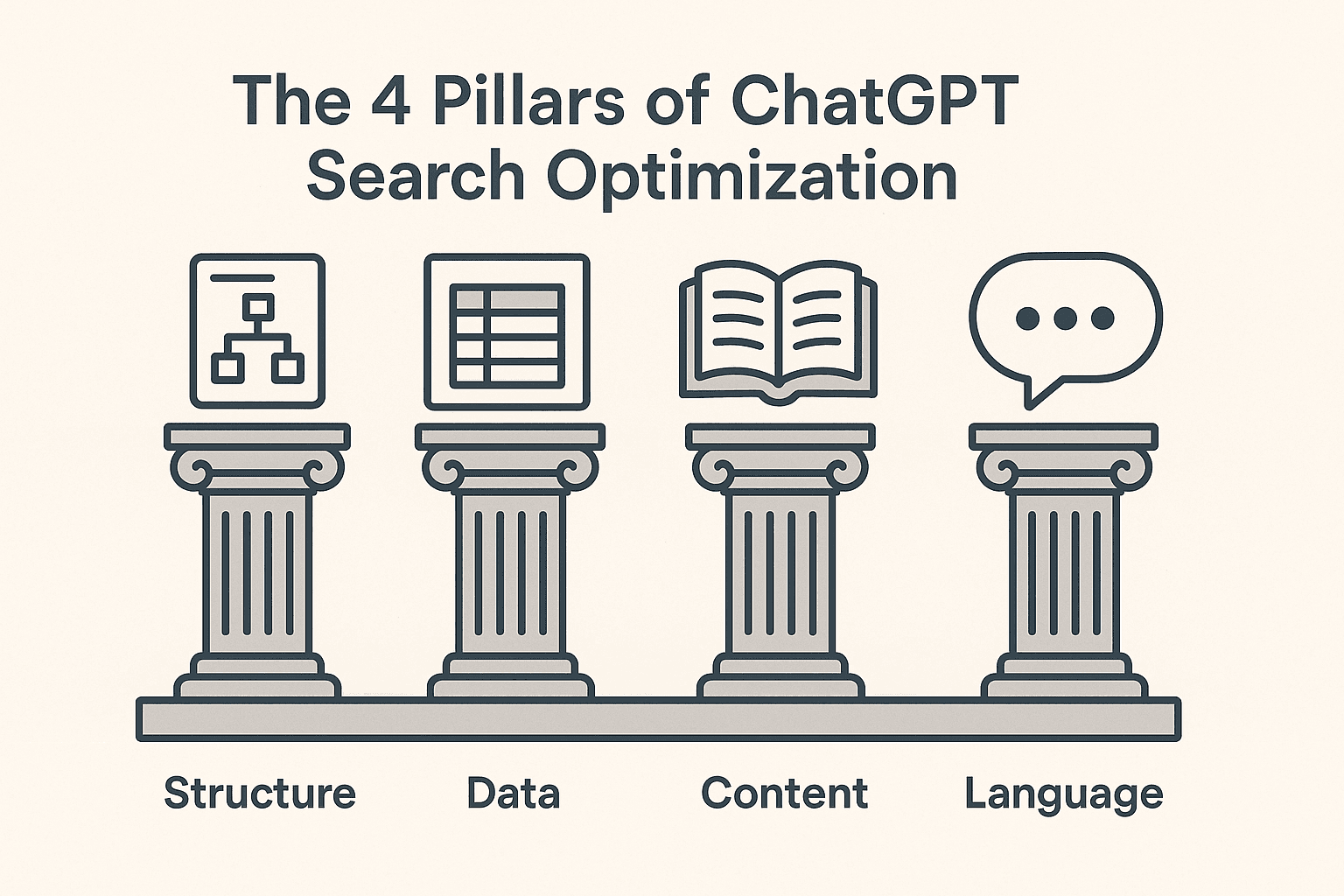
4 Pillars of ChatGPT SEO
AI search optimization rests on four foundational pillars. Focus your limited resources here first. These aren't theoretical concepts - they're practical frameworks that drive results.
Pillar 1: Content Structure & Clarity
AI models scan for clear, hierarchical information structures. When ChatGPT encounters your page, it needs to quickly understand what information you're providing and how it's organized. Proper structure makes this possible.
Use proper heading hierarchy. H1 leads to H2 leads to H3. This isn't about visual design - it's about information architecture. Each heading level should indicate the relationship and importance of the content beneath it. AI models use this hierarchy to understand your content's structure.
Write self-contained sections. Each section should make sense independently. Don't reference "as mentioned above" or "we'll cover this later." When an AI model pulls a section to answer a question, users won't have the surrounding context. Make every section complete.
Include context and definitions. Never assume prior knowledge. If you mention "webhooks," explain what they are. If you reference "OAuth 2.0," provide a brief definition. This extra context helps AI models serve your content to users at different knowledge levels.
Use descriptive subheadings. Instead of clever or vague headings like "Getting Started," use "How to Create Your First Integration in 5 Minutes." Descriptive headings tell readers (and AI models) exactly what they'll learn in that section.
Here's a practical example:
Bad: "Use our API to connect."
Good: "Use our REST API to connect your application. The API accepts JSON requests at https://api.yourcompany.com/v1 and returns structured data about customer transactions. Authentication requires an API key from your dashboard. Generate your key under Settings → API Access, then include it in the Authorization header of each request: `Authorization: Bearer YOUR_API_KEY`."
The second version gives AI models everything they need to explain to a user how your API works.
Pillar 2: Structured Data Implementation
Schema markup acts as a direct line to AI models. When they crawl your site, structured data is often the first thing they read and the easiest to parse. This makes schema implementation one of the highest-ROI activities for AI search optimization.
Priority schema types for startups:
Organization schema provides basic company information: name, founding date, location, contact details, social profiles. This helps AI models understand who you are and establish your legitimacy.
Product schema describes what you sell: features, pricing (if public), customer reviews, availability. When someone asks ChatGPT about products in your category, Product schema helps you appear in those results.
Article schema marks up blog posts with metadata: author, publish date, modified date, images. This signals fresh, maintained content that AI models prefer to surface.
FAQPage schema is particularly powerful for AI search. It structures question-answer pairs in a machine-readable format. When users ask those exact questions (or close variations), your answers can appear directly.
SoftwareApplication schema works for SaaS products, providing details about your application: operating system, features, pricing model, screenshots.
Quick win for today: Add Organization schema to your homepage using Google's Structured Data Markup Helper (search for it - it's free). This takes 15 minutes and immediately makes your company more discoverable.
Validate your implementation using Google's Rich Results Test or the Schema.org validator. Don't trust that you got it right - verify.
Is ChatGPT good for SEO? Yes, if you give it structured information to work with. Schema markup is how you do that.
Pillar 3: Comprehensive, Evidence-Based Content
AI models strongly favor depth, specificity, and cited sources over surface-level content. "Comprehensive" doesn't mean long - it means complete. Address the topic from multiple angles. Include benefits and drawbacks. Mention alternatives. Acknowledge edge cases.
Include methodology and reasoning. Don't just state conclusions. Show how you reached them. "Our tests showed a 40% improvement" is weak. "We tested 12 remote teams over 3 months, measuring completed tasks per sprint. Teams averaged 23% more completions, with the highest improvements (31%) in distributed time zones and lowest (15%) in co-located teams. We excluded teams under 10 people as results varied significantly" is strong.
Back claims with data. Every significant claim needs support. Link to research. Cite studies. Reference your own data. Provide customer examples with real numbers. AI models trained on academic papers and high-quality sources recognize and reward evidence-based writing.
Show your work. Explain how features work, why you made certain design decisions, what trade-offs exist. When you say "our system handles 10,000 requests per second," add "under test conditions with 512MB RAM per instance, averaging 50ms response time, with 99.9% success rate." Specificity signals expertise.
Acknowledge limitations. Nothing works for everyone. "Our tool is perfect for X but not ideal for Y" is more trustworthy than "our tool is perfect for everyone." AI models recognize balanced perspectives.
Real example transformation:
Before: "Our productivity tool increases team output by improving collaboration and reducing meeting time."
After: "In a 3-month pilot with 12 remote teams (50-200 employees each), teams using our tool completed an average of 23% more tasks per sprint compared to the prior quarter. The increase was highest for teams with distributed time zones (31% improvement) and lowest for co-located teams (15%). We measured 'tasks completed' as items moved to 'Done' in their project management tool. Teams spent an average of 2.5 fewer hours per week in meetings. We excluded teams under 10 people from our analysis as results varied significantly, likely due to different working styles in very small groups."
The second version gives AI models confidence to recommend your tool with specific context about who benefits most.
Pillar 4: Natural Language Optimization
People don't type keywords into ChatGPT. They ask questions in natural language: "What's the best email marketing tool for a small e-commerce business that's just starting out?" Your content needs to match this conversational style.
Map common customer questions. Check your support tickets. Listen to sales calls. What questions do prospects ask repeatedly? These are the questions people will ask AI assistants.
Structure FAQ content properly. Write the actual question customers ask, then provide a complete answer. Don't paraphrase the question. Don't make it corporate-speak. Use the real question.
Answer the why and how, not just the what. "We charge $49/month" answers what. "We charge $49/month per active user. An active user is anyone who logs in at least once during the billing cycle. If you add 5 users on day 15 of your monthly cycle, you pay 50% of the monthly rate for those users in their first month. You can add or remove users anytime - we calculate charges daily and bill monthly" answers why and how.
Include question variations. People ask the same thing different ways. "How much does it cost?" "What's your pricing?" "How does billing work?" Create content that addresses all variations.
Use conversational language. Write like you talk. "You can integrate with Slack in three steps" beats "Slack integration is achievable via a three-step process." Clear, direct language helps both humans and AI models.
Example FAQ structure:
Question: "How does your pricing work for growing teams that add people frequently?"
Answer: "We charge $45 per active user per month. An 'active user' is anyone who logs into the platform at least once during the billing period. Here's how it works when you're scaling: If you add 5 new team members on day 15 of your monthly cycle, you pay 50% of the monthly rate ($22.50 per person) for those users in their first partial month. The next month, they're charged the full $45. If someone leaves and doesn't log in for a full billing cycle, you're not charged for them that month. You can add or remove users anytime through your admin dashboard - changes take effect immediately. We calculate actual usage daily and bill monthly, so you only pay for the people actively using the platform."
This answers the question completely. Users reading it get all the information they need. AI models can extract specific details to answer related questions.
Technical Requirements for AI Discoverability
Content quality matters most, but technical foundations determine whether AI models can access your content at all. Get these basics right first.
Ensure your site is crawlable. Check your robots.txt file. Make sure you're not accidentally blocking AI crawlers. Create and submit an XML sitemap. Verify it's error-free in Google Search Console. AI models often use the same crawling infrastructure as traditional search engines.
Page speed and Core Web Vitals still matter. Slow sites frustrate users, and AI models seem to favor sites with good performance metrics. Get your pages loading in under 3 seconds. Optimize images. Minimize JavaScript. Use a CDN if you serve a global audience.
Mobile-first is critical. More than 60% of web traffic comes from mobile devices. If your site doesn't work well on mobile, you're invisible to a majority of potential customers. AI models appear to prefer mobile-friendly sites, likely because that's how most of their training data was accessed.
SSL/HTTPS is mandatory. If you're still running HTTP in 2024, fix this immediately. Modern browsers warn users about unsecure sites. AI models deprioritize or exclude HTTP sites from results.
Use clean, semantic HTML. Proper HTML structure helps AI models parse your content. Use <article> tags for articles. Use <nav> for navigation. Use <aside> for sidebars. Semantic HTML communicates content structure beyond just visual layout.
Quick technical checklist:
[ ] robots.txt allows all legitimate crawlers (including AI user agents)
[ ] XML sitemap submitted to Google Search Console and error-free
[ ] All pages load in under 3 seconds (test with PageSpeed Insights)
[ ] Schema markup implemented on key pages (validate with Rich Results Test)
[ ] HTTPS enabled sitewide (no mixed content warnings)
[ ] Responsive design working properly on phones, tablets, and desktops
Which is the best AI tool for SEO? Start with free tools: Google Search Console for monitoring crawlability and traffic, PageSpeed Insights for performance, and Google's Rich Results Test for schema validation. These free tools handle 90% of what startups need.
Content Strategy for Resource-Constrained Startups
You don't have time to write 100 blog posts. You don't have a content team. You're barely keeping up with product development. Here's what actually works with limited resources.
The 80/20 Content Approach
Focus on three content types that drive disproportionate results:
1. Cornerstone guides (2-4 pieces)
Create 2-4 comprehensive guides on your core topics. These should be 3,000+ words each - real, meaty content that thoroughly covers the subject. These pieces become your authority signals.
Don't create and abandon them. Update these guides quarterly. Add new sections as your product evolves. Keep them current. AI models favor recently updated content.
Example: If you sell email marketing software, write "The Complete Guide to Email Deliverability for SaaS Companies." Cover everything: SPF, DKIM, DMARC, sender reputation, IP warming, content best practices, list hygiene, engagement metrics, recovery strategies. Make it the definitive resource.
2. Customer proof (ongoing, low effort)
Case studies with real metrics demonstrate that your product works. Don't write corporate marketing speak. Let customers tell their stories in their own words.
"Company X increased revenue by 40%" is okay. "We were sending 50,000 emails per month with a 12% open rate. After switching to [Product] and implementing their segmentation recommendations, our open rate hit 28% within 6 weeks. That translated to 40 additional demo bookings per month and $180K in new quarterly revenue" is much better.
Customer testimonials need specific outcomes. Not "great product!" but "reduced our deployment time from 3 hours to 15 minutes, which means our small team can ship updates daily instead of weekly."
AI models trust authentic customer voices more than marketing copy. Before/after scenarios with real numbers carry weight.
3. Technical documentation (required)
Document how your product actually works. Features, integrations, APIs, implementation guides, troubleshooting steps, use cases, examples. This content shows expertise and helps AI understand what you actually do.
If you have an API, document it thoroughly. If you have integrations, explain exactly how they work. If you have features, write how-to guides with screenshots.
This documentation often becomes your most valuable AI search asset because it's specific, detailed, and factual - exactly what AI models look for.
What to skip:
Generic industry news commentary ("5 Trends in Marketing Automation") - everyone writes these and they say nothing new
Short blog posts that provide no real value - 300 words of fluff helps nobody
Keyword-stuffed landing pages - AI models ignore these
AI-generated content without heavy human editing - it's obvious and it doesn't work
Building Topical Authority Without a Content Team
The cluster strategy works even with no dedicated content resources:
Pick ONE core topic you can own. Not ten topics. One. The thing you know better than anyone else.
Create a hub page - a comprehensive guide (2,000-4,000 words) that covers this topic thoroughly.
Create 5-8 supporting articles that dive deep into specific aspects. Each links back to the hub page.
Interlink all related content. When you mention a concept covered elsewhere, link to it.
Go deep, not wide. Master one topic completely before expanding to others.
Real example: A 3-person startup focused entirely on "API security for fintech companies." They created:
One hub guide (5,000 words): "Complete API Security Guide for Fintech"
Six supporting pieces: PCI compliance, OAuth implementation, rate limiting, audit logging, encryption standards, incident response
Just six pieces of content. They now appear in 8 out of 10 ChatGPT queries about API security in their niche, outranking companies with 200+ blog posts. Depth beat breadth.
Can SEO be done with AI? Yes, but it requires effort. Is AI SEO worth it? For these startups, appearing in AI search results drives 20-30% of their qualified leads. You decide if that's worth it.
Leverage What You Already Have
You're already creating content - you're just not publishing it. Quick wins:
Turn customer onboarding emails into public documentation. That email sequence teaching new users how to get started? That's documentation. Publish it.
Convert sales call FAQs into structured Q&A content. Your sales team answers the same questions daily. Document those answers. Create a comprehensive FAQ page.
Expand help docs into comprehensive guides. Your support articles solve specific problems. Expand them into complete guides that cover the problem, solution, implementation, and common issues.
Transform internal wiki pages into public knowledge base articles. Internal documentation about how things work can become external content (obviously exclude proprietary details). Your process documentation can help others understand your approach.
How to Actually Measure AI Search Performance
Google Analytics won't show "ChatGPT" as a traffic source. AI search requires different measurement approaches.
Direct Measurement (Manual but Accurate)
Weekly monitoring protocol:
Create a list of 10-15 queries related to your product or service
Ask ChatGPT each query in a fresh conversation
Document whether you're mentioned, your position, and the context
Track changes week over week
Example queries for an email marketing tool:
"What are the best email marketing platforms for startups?"
"How do I improve email deliverability for my SaaS company?"
"Email marketing software with good API for developers"
"Which email tools integrate with Shopify?"
"Affordable email marketing for small business under $100/month"
Tracking template: ``` Query: "What are the best email marketing platforms for startups?" Date: 2024-11-09 Mentioned: Yes Position: Third option (after Mailchimp and ConvertKit) Context: Mentioned positively for API capabilities and developer-friendly features Notes: Not mentioned for general use case, only when API was priority ```
Run this check weekly. Track whether you're appearing more frequently, moving up in position, or being mentioned in better context.
Proxy Metrics That Signal AI Search Impact
1. Brand search volume
Track searches for "[your company name]" in Google Search Console. When people discover you through ChatGPT, many will then search Google for your company name. Spikes in brand searches often correlate with AI search visibility.
2. Direct traffic patterns
Monitor direct traffic in analytics, especially from new users. Many AI search clicks appear as "direct" because there's no referral information. Look for:
Increases in direct traffic from new users
Referrer-less sessions from mobile devices
Direct visits that go straight to specific product or documentation pages
3. Customer attribution
Ask during signup, sales calls, or post-purchase surveys: "How did you first hear about us?" Include "AI assistant recommendation" or "ChatGPT" as an explicit option. Track this metric monthly.
4. Page engagement without clear source
Monitor which pages get visited without referral data but show high engagement (long time on page, high scroll depth, multiple page views). This often indicates AI search traffic - users arrive without traditional referrals but engage deeply because they came with intent.
Competitive Intelligence
Monthly competitive check:
Search for your product category on ChatGPT ("best [category] for [use case]")
Note which 3-5 competitors consistently appear
Visit their sites and analyze their content structure, topics covered, and schema implementation
Identify gaps you can fill or areas where you have stronger expertise
Real data from our own tracking: We monitored 50 product-related queries over 3 months. Our mention rate went from 12% (6 out of 50 queries) to 58% (29 out of 50) after implementing structured data and publishing three comprehensive guides. Direct traffic from new users increased 34% over the same period.
Common Mistakes to Avoid
Learn from others' errors. These mistakes hurt AI search visibility:
1. Abandoning traditional SEO completely
AI search is additive, not replacement. Google still drives most web traffic. Companies that abandoned traditional SEO to focus solely on AI optimization saw overall traffic decline. Do both.
2. Using thin, AI-generated content without human oversight
One startup used AI tools to generate 50 blog posts in a week. None provided real value. Their AI search visibility actually decreased. ChatGPT and other AI models were trained to recognize quality content - they spot AI-generated fluff easily.
Quality beats quantity. Always. A human expert writing 3 comprehensive guides beats 50 AI-generated posts with no expertise.
3. Hiding important information behind forms or logins
Another company put all their documentation behind a login wall, requiring email signup to access API docs. This made their entire knowledge base invisible to AI search. They got zero mentions in AI results for 2 months before they figured out why.
Public content gets indexed. Private content doesn't. Balance lead generation with discoverability.
4. Ignoring mobile users
If your site doesn't work on mobile, you're invisible to 60%+ of users and deprioritized by AI models. Test on actual phones, not just browser resize. Fix mobile issues before optimizing anything else.
5. Over-optimization or manipulation tactics
Keyword stuffing, hidden text, manipulative schemas, fake reviews - these tactics worked (sometimes) against simpler algorithms. AI models trained on millions of high-quality documents recognize these patterns instantly. They hurt more than they help.
The pattern: shortcuts don't work. Quality, clarity, and authenticity win.
Quick Wins for Startups
You can implement these today. Each takes under 2 hours and delivers measurable impact:
1. Add comprehensive About Us and Team pages
Real names, real photos, backgrounds, expertise. AI models use this to establish legitimacy and authority. Include founding date, location, team size, mission. Make it specific: "Founded in 2022 by former Salesforce engineers who got frustrated with..." beats generic corporate speak.
2. Create an FAQ page answering your top 10 customer questions
Pull these directly from support tickets and sales calls. Use the actual questions customers ask. Provide complete answers. Implement FAQPage schema markup. This single page can drive 20-30% of your AI search visibility.
3. Implement basic schema markup
Organization schema on your homepage, Product schema on key product pages. Use Google's Structured Data Markup Helper - it walks you through the process. Takes 30 minutes. Validate with Rich Results Test.
4. Write one comprehensive guide on your core topic
2,000-3,000 words covering your main expertise area thoroughly. Use proper heading structure. Include examples, data, and specific details. This becomes your cornerstone content and primary authority signal.
5. Add customer testimonials with specific results
Not "Great product!" but "Reduced deployment time from 3 hours to 15 minutes, saving our team 10 hours per week." Real names, real companies (with permission), real metrics. These signals of customer success improve trust and authority.
What are the best free AI tools for SEO? You already have access to most of what you need:
Google Search Console (free) - monitor crawlability, track brand searches, identify issues
Schema.org Markup Generator (free) - create structured data without coding
Google Rich Results Test (free) - validate your schema implementation
PageSpeed Insights (free) - check site performance
ChatGPT itself (free version available) - test your visibility directly
Paid tools can help, but these free resources cover the fundamentals. Start here before spending money.
The Future of AI Search Optimization
AI search is evolving rapidly. ChatGPT added search functionality in 2024. Perplexity grew from unknown to mainstream. Google integrated AI overviews. This space is changing fast.
Here's what matters: principles outlast tactics. Focus on quality, authority, and clarity. These won't change regardless of which AI models gain popularity or how search interfaces evolve.
Build for your users first. When you solve real problems with clear, comprehensive information, AI will follow. Models are trained to identify and surface quality content. Create quality content.
Adaptability matters more for startups than for established companies. You can pivot quickly. You can update content without bureaucracy. You can try new approaches and measure results within weeks. Use this advantage.
Will SEO be replaced by AI? No. SEO is transforming, not dying. The fundamentals remain: create valuable content, make it technically accessible, build authority in your domain. The methods evolve, but the principles hold.
Observable trends right now:
AI models increasingly favor recent, updated content over old static pages
Structured data appears more important than ever for AI visibility
Conversational, question-answering content formats perform better
Authority signals (expert authors, cited sources, customer proof) carry more weight
Page experience and technical quality matter for AI crawling
Stay informed. Check your AI search visibility monthly. Adjust based on what you observe. The startups winning in AI search aren't lucky - they're paying attention and iterating.
Conclusion and Next Steps
AI search optimization comes down to four core principles:
Clarity over cleverness - Clear, well-structured content beats keyword-optimized text
Authority through depth - Comprehensive expertise on one topic beats surface coverage of many
Quality for humans first - Content that helps real people helps AI search
Consistent measurement - Track your visibility, learn what works, iterate
Technical foundations matter - schema markup, crawlability, performance. But they're table stakes. Quality content with clear information architecture is what actually drives visibility in AI search results.
Start small. You don't need to overhaul your entire website this week. Pick one high-value page - your homepage, your main product page, or your most important guide. Apply the 4 pillars to that single page:
Fix the content structure with proper headings and self-contained sections
Add schema markup for that page type
Expand thin content into comprehensive, evidence-based information
Optimize for natural language questions customers actually ask
Measure the result. Check if that page appears in ChatGPT results for relevant queries. Track brand searches and direct traffic. Monitor customer attribution.
Then do it again with the next page.
Sources: businessofapps.com, blog.google, businessofapps.com, blog.hubspot.com, https://youtu.be/VPC6Ehrhj1E
This is how startups with limited resources win: focused effort on high-impact pages, consistent measurement, continuous iteration. You don't need a content team or a large budget. You need clarity about your expertise and the discipline to communicate it well.
Your next step: Choose one page. Spend 2 hours improving it using this guide. Check back in a week to see if it appears in AI search results. That's how you start.

Peter Frank
GEO Strategist
Ready to Optimize for AI Search?
Join thousands of marketers who are already using LLMScout to track and improve their performance in AI search results.
Get Early Access