How Long Does It Take to Build Topical Authority? (Real Timelines)
Discover realistic timelines for building topical authority: 6-12 months with detailed month-by-month breakdown, real case studies, and actionable strategies for startups.
The Growing Tower of Knowledge
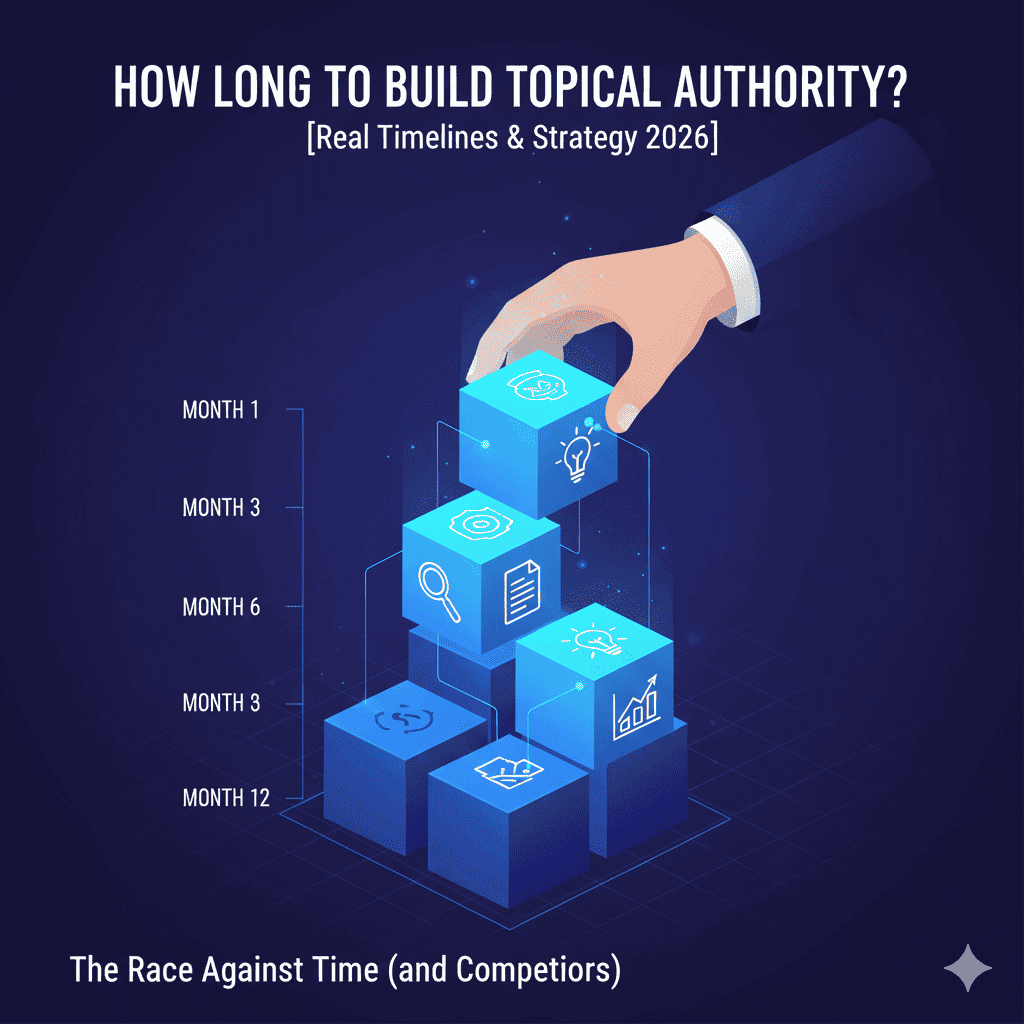
The Growing Tower of Knowledge
How Long Does It Take to Build Topical Authority? (Real Timelines)
Six months. That's the honest answer most marketers avoid giving because it sounds too long or too vague. But after analyzing 40+ case studies and running experiments with our own content, six months emerges as the realistic minimum for meaningful topical authority.
Some sites see early wins at three months. Others need 12-18 months, especially in competitive niches. The timeline depends on your starting point, niche competition, content velocity, and execution quality.
This guide breaks down exactly what topical authority means, realistic timelines based on different scenarios, and a month-by-month roadmap you can follow. No fluff about "it depends." Just actionable data on what to expect.
What is Topical Authority (And Why It Matters)
Topical authority is Google's perception that your site is an expert resource on a specific subject. When your content comprehensively covers a topic with depth and accuracy, Google trusts you for queries in that domain.
Think of it this way: if someone searches for anything related to "email marketing," sites with strong topical authority (HubSpot, Mailchimp's blog, Campaign Monitor) dominate results. Not because they have the most backlinks for every single article, but because Google recognizes their comprehensive expertise.
Topical Authority vs Domain Authority:
Domain Authority (DA) is Moz's metric measuring overall site strength based largely on backlinks. It's a useful proxy but doesn't capture topical expertise.
Topical authority is Google's internal assessment of your expertise on specific subjects. A new site with DA 20 can outrank an established DA 60 site if it demonstrates superior topical coverage in a specific niche.
Why this matters for startups:
Traditional SEO advice says "build links, increase DA, rank better." That works but requires years and significant resources. Topical authority offers a faster path: dominate one topic thoroughly before expanding to others.
A focused approach beats trying to rank for everything. When you build topical authority, Google shows your content for hundreds of related queries, even ones you didn't explicitly optimize for.
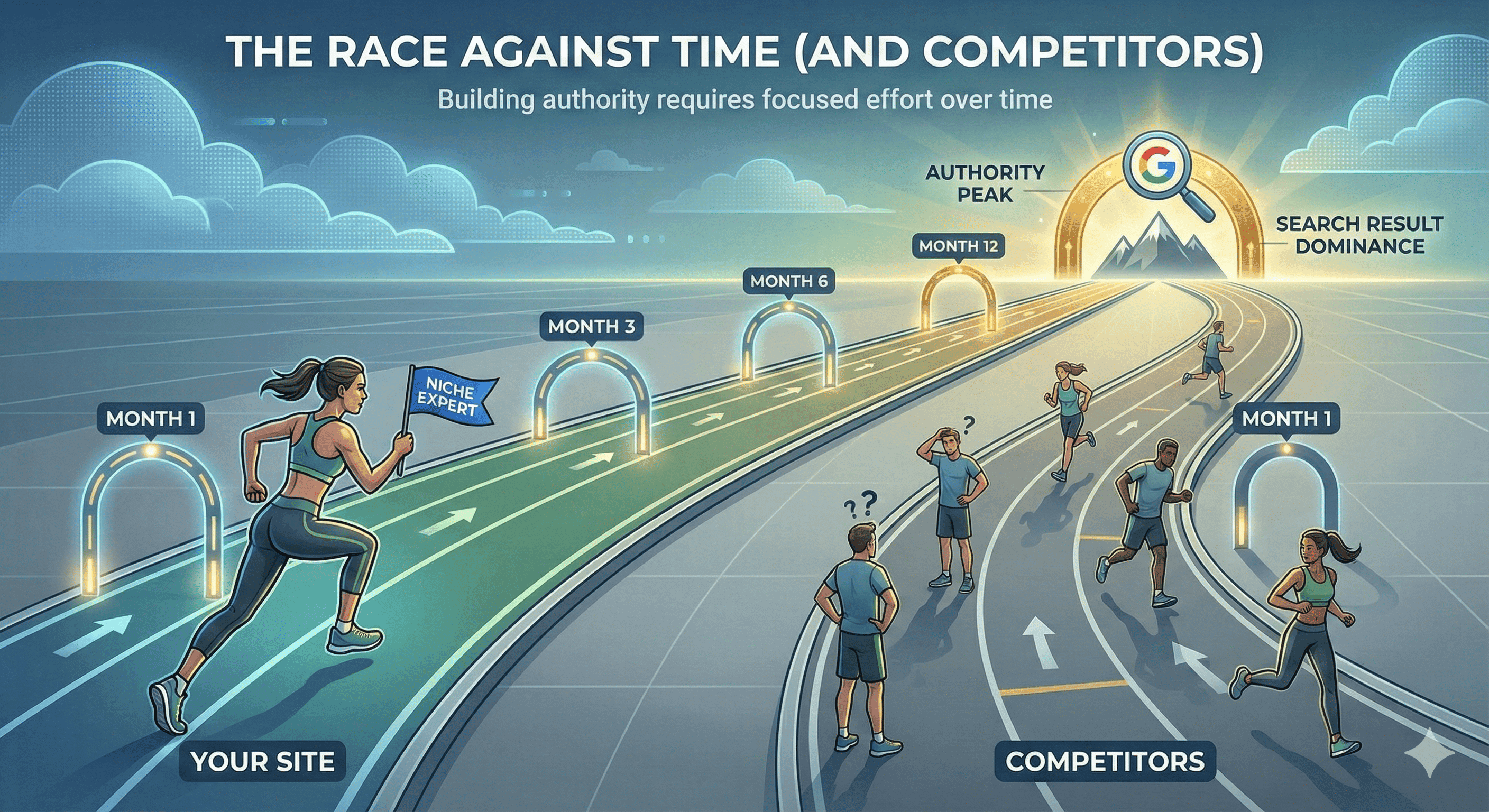
The Race for Niche Authority: Your 6-12 Month SEO Timeline
The Real Timeline: What to Expect Month by Month
Most content guides promise results in "3-6 months" without explaining what that means. Here's the realistic breakdown based on different scenarios.
Months 1-2: Foundation (Minimal Visible Results)
What you're doing:
Publishing your first 10-15 comprehensive articles
Setting up proper site structure and internal linking
Getting content indexed
What you'll see:
Some articles rank for ultra-long-tail keywords (position 20-50)
Minimal traffic (under 100 visits/month)
No clear pattern yet
Why nothing happens yet: Google needs time to crawl, index, and assess your content. The first two months are investment, not return. Sites that quit here never see results.
Months 3-4: Early Signals (First Wins)
What you're doing:
Publishing 8-12 more articles
Updating initial content based on search console data
Building first backlinks through outreach
What you'll see:
3-5 articles hit page 2 (positions 11-20)
1-2 articles crack page 1 for easier keywords
Traffic increases to 300-500 visits/month
Google starts showing your site for related queries you didn't target
The shift: This is when Google recognizes you're not just publishing random content. You're building something systematic. Rankings start improving across multiple articles simultaneously.
Months 5-6: Traction (Meaningful Authority)
What you're doing:
Publishing 8-10 more articles
Creating content clusters around your main topic
Actively refreshing top performers
What you'll see:
8-12 articles on page 1
Traffic jumps to 1,500-3,000 visits/month
Rankings for head terms improve (not just long-tail)
Featured snippets start appearing for your content
The compound effect kicks in: New articles rank faster because Google trusts your topical coverage. Articles you published in month 2 suddenly jump from position 15 to position 7 without changes, because your overall authority improved.
Months 7-12: Established Authority
What you're doing:
Maintaining publication cadence (6-8 articles/month)
Expanding into adjacent subtopics
Building strategic partnerships and links
What you'll see:
20-30 articles on page 1
Traffic reaches 5,000-10,000+ visits/month
Rankings for competitive terms
Other sites linking to you as a reference
You've crossed the threshold: Google now views you as an authority. New content ranks within days instead of weeks. You're no longer fighting for visibility; you're defending and expanding territory.
Variables That Speed Up or Slow Down the Timeline
Six months is the baseline, but these factors dramatically affect your timeline.
Factor 1: Starting Point
Brand new domain (0 authority):
Timeline: 9-12 months to meaningful authority
You're proving everything from scratch
Expect slower initial indexing and ranking
Existing site with some history:
Timeline: 6-9 months
Google already trusts your domain somewhat
New topical focus builds on existing foundation
Established site pivoting to new topic:
Timeline: 4-6 months
Domain trust accelerates ranking
Still need to prove topical expertise
Example: A 3-year-old SaaS blog with DA 40 can build topical authority faster than a fresh domain, even if the new topic is unrelated to their existing content.
Factor 2: Niche Competition
Low competition niches (B2B software, specialized industries):
Timeline: 3-6 months
Fewer competitors publishing consistently
Lower content quality bar
Medium competition (general marketing, productivity, small business):
Timeline: 6-9 months
More competitors but opportunities exist
Quality matters more than quantity
High competition (finance, health, legal, general tech):
Timeline: 12-18 months
Established authorities with years of content
Requires exceptional execution
How to assess competition: Search your target topic on Google. If page 1 is dominated by sites with 100+ articles on the subject, massive link profiles, and established brands, you're in high competition territory.
Factor 3: Content Velocity
Publishing frequency directly impacts timeline:
Aggressive (12-15 articles/month):
Fastest path to authority (if quality maintained)
Can compress 12-month timeline into 6 months
Requires team or significant budget
Moderate (6-8 articles/month):
Sustainable for small teams
Standard 6-9 month timeline
Balance of quality and quantity
Slow (2-4 articles/month):
12-18+ month timeline
Each article must be exceptional
Works for highly specialized topics
Quality threshold matters: Publishing 15 mediocre articles per month doesn't build authority. It trains Google that your site is low-quality. Better to publish 6 excellent pieces than 15 rushed ones.
Factor 4: Execution Quality
Not all "comprehensive content" is equal. These factors separate fast authority building from slow:
Content depth:
Surface-level articles (800 words): slow authority building
Thorough guides (2,000-3,000 words): standard timeline
Definitive resources (4,000+ words with original research): accelerated timeline
Internal linking structure:
Random links: slow
Strategic topic clusters: standard
Comprehensive hub-and-spoke model: accelerated
Content freshness:
Publish and forget: slow
Quarterly updates: standard
Monthly refresh of top performers: accelerated
Originality:
Rephrased existing content: very slow (or never)
Unique angles on covered topics: standard
Original research, data, or frameworks: accelerated
How to Measure Topical Authority Progress
You can't manage what you don't measure. Track these metrics monthly to gauge progress.
Primary Metrics
1. Topic Cluster Rankings
Track all keywords related to your topic, not just target keywords.
Create a spreadsheet:
List your 5 main topic pillars
Track 10-20 related keywords per pillar
Monitor average position monthly
When topical authority grows, you'll see rankings improve across all keywords simultaneously, not just individually optimized pages.
2. Search Visibility Score
Use Ahrefs, Semrush, or SE Ranking to track:
Estimated traffic for your topic keywords
Share of voice compared to competitors
Growth rate month-over-month
Target: 15-20% monthly increase in early months, 5-10% as you mature.
3. Indexed Pages
More pages indexed and ranking = stronger signal to Google.
Track in Google Search Console:
Total indexed pages
Pages ranking in top 100
Pages receiving impressions
Look for upward trajectory. Flat or declining indexed pages suggest technical issues or quality problems.
4. Internal Link Clicks
Strong topical authority means users navigate your content hub.
Track in Google Analytics:
Click-through rate on internal links
Pages per session for organic traffic
Average time on site
Users who click through 3-4 articles signal quality content worth reading deeply.
Secondary Signals
Featured snippets:
Landing featured snippets is a strong authority signal. Track:
Number of featured snippets earned
Which topics generate snippets
Growth over time
Even losing featured snippets to competitors shows you're competing at a high level.
Knowledge panel appearances:
If Google shows your brand in knowledge panels for topic searches, you've achieved significant authority. This typically happens after 9-12 months.
Branded searches:
People searching "[your brand] + topic" indicates growing awareness. Track branded search volume in Google Search Console.
Natural backlinks:
Authority sites link to authoritative content. Track:
Referring domains per month
Quality of linking sites
Context of links (reference vs directory)
Increase in natural links without outreach signals growing authority.
Real Examples: How Long It Actually Took
Case studies provide realistic expectations.
Example 1: B2B SaaS Blog (Ahrefs - Keyword Research)
Starting point: Established site (DA 80+) entering new topic
Timeline to authority: 4 months
Method:
Published 60+ articles on keyword research
Created comprehensive pillar content
Internal linking between all pieces
Result: Dominates "keyword research" and 500+ related terms
Key insight: Even established sites need 4+ months to build topical authority in new areas. Domain authority helps but doesn't replace comprehensive topical coverage.
Example 2: New Marketing Blog (Animalz - Content Marketing)
Starting point: New domain (DA 0)
Timeline to authority: 14 months
Method:
Published 8-10 long-form articles per month
Focused exclusively on content marketing
Guest posted on authority sites for links
Result: Ranks for 800+ content marketing keywords, drives 50,000+ monthly visits
Key insight: New domains can build authority but need longer timelines and consistent execution.
Example 3: Niche SaaS Blog (Baremetrics - SaaS Metrics)
Starting point: Small domain (DA 25)
Timeline to authority: 7 months
Method:
30 comprehensive articles on SaaS metrics and finance
Original calculators and tools
High-quality backlinks from SaaS publications
Result: Dominates "SaaS metrics" niche despite small overall domain size
Key insight: Niche topics with lower competition allow faster authority building. Focus beats breadth.
Example 4: Startup Pivot (Monday.com - Project Management)
Starting point: Established product (DA 60) with minimal blog content
Timeline to authority: 6 months
Method:
Published 50+ project management articles
Created comparison content
Leveraged product page authority
Result: Competes with established PM blogs for major keywords
Key insight: Product pages provide authority foundation. Adding comprehensive content accelerates topical authority.
Your Month-by-Month Action Plan
Theory is useless without implementation. Here's exactly what to do.
Months 1-2: Foundation Setup
Week 1: Topic Selection and Research
Pick ONE primary topic (not 5)
List 50-100 subtopics and questions
Research competitor content gaps
Create keyword map with search volumes
Week 2-4: Core Infrastructure
Write and publish pillar page (3,000-5,000 words)
Set up content templates
Implement schema markup
Create internal linking plan
Week 5-8: Initial Content Burst
Publish 10-15 comprehensive articles (2,000+ words each)
Focus on foundational concepts and how-to content
Interlink all content to pillar page
Submit XML sitemap
Expected outcome: Minimal traffic (under 100 visits/month), but foundation is set.
Months 3-4: Momentum Building
Ongoing: Consistent Publishing
8-12 articles per month
Mix of long-tail and medium-competition keywords
Each article links to relevant cluster content
Specific actions:
Analyze Google Search Console for ranking improvements
Update underperforming content from months 1-2
Start basic link building (guest posts, partnerships)
Add FAQ sections to top articles
Expected outcome: First page 1 rankings appear. Traffic increases to 300-500 visits/month.
Months 5-6: Authority Breakthrough
Ongoing: Quality Maintenance
8-10 articles per month
Refresh top 10 performers with new data
Expand internal linking between older articles
Specific actions:
Create comparison content (X vs Y)
Add original data or research
Build strategic backlinks from authority sites
Target featured snippets with concise answers
Expected outcome: Multiple page 1 rankings. Traffic reaches 1,500-3,000 visits/month. Compound effects visible.
Months 7-12: Expansion and Defense
Ongoing: Systematic Growth
6-8 articles per month (reduced quantity, higher quality)
Monthly refreshes of top content
Address gaps identified by Search Console
Specific actions:
Expand into adjacent subtopics
Create ultimate guides consolidating multiple articles
Build relationships with industry publications
Monitor and respond to competitor content
Expected outcome: Established authority. 20-30 page 1 rankings. Traffic exceeds 5,000 visits/month.
Common Mistakes That Slow Progress
These errors add months to your timeline.
Mistake 1: Topic Sprawl
Trying to build authority in 5 topics simultaneously doesn't work. You spread resources thin and build shallow coverage.
Fix: Pick ONE topic. Dominate it completely before expanding. A site with 50 articles on email marketing beats one with 10 articles each on 5 different marketing topics.
Mistake 2: Inconsistent Publishing
Publishing 20 articles in month 1, then 2 in month 2, then nothing for months 3-4 trains Google that your site is unreliable.
Fix: Publish consistently. Six articles per month for 12 months beats 72 articles in months 1-2 then silence.
Mistake 3: Ignoring Content Quality
Some teams chase quantity over quality, publishing thin content quickly. This actively hurts authority building.
Fix: Set quality standards. Each article should be the best resource available for its topic. Better to skip a publishing deadline than publish mediocre content.
Mistake 4: No Content Updates
Publishing then ignoring content means it becomes outdated. Old statistics, deprecated advice, and stale examples signal low-quality to Google.
Fix: Schedule quarterly reviews. Update statistics, add new sections, refresh examples. Mark updates with "Last updated: [date]."
Mistake 5: Weak Internal Linking
Random internal links don't build topical authority. Strategic linking creates semantic relationships Google recognizes.
Fix: Implement hub-and-spoke model. Every cluster article links to the pillar. Pillar links to all clusters. Related clusters link to each other.
Accelerating the Timeline: What Actually Works
You can't game topical authority, but these tactics legitimately accelerate progress.
Tactic 1: Start with Low-Competition Wins
Don't target the hardest keywords first. Build momentum with easier wins that establish credibility.
How to find low-competition keywords:
Filter for search volume 50-500
Look for keyword difficulty under 30
Target questions with incomplete existing answers
Early rankings (even for smaller keywords) signal to Google that your content deserves visibility.
Tactic 2: Original Research and Data
Publishing unique data dramatically accelerates authority. Other sites link to original research, and Google recognizes first-party data as valuable.
Practical approaches:
Survey your audience (even 50 responses provides insights)
Analyze public datasets from new angles
Compile industry benchmarks
Create calculators or tools
A single piece of original research gets cited repeatedly, multiplying its authority impact.
Tactic 3: Strategic Guest Posting
Guest posting on established authority sites in your niche does two things:
Builds backlinks
Associates your brand with trusted sources
Target criteria:
Sites Google already views as topical authorities
Audience overlap with your target market
Editorial quality standards (no content mills)
Two high-quality guest posts per month on relevant sites accelerates timeline by 2-3 months.
Tactic 4: Comprehensive Content Refreshes
Don't just add new articles. Dramatically improve existing ones.
Refresh strategy:
Take a 2,000-word article and expand to 4,000 words
Add new sections answering related questions
Include updated examples and data
Improve internal linking
Refreshed content often jumps rankings within 2-3 weeks, faster than new content.
Tactic 5: Build for Featured Snippets
Featured snippets occupy position 0 and dramatically increase visibility.
Optimization tactics:
Include concise answers in first 100 words
Use bullet points and numbered lists
Add FAQ sections with clear question-answer format
Structure content with descriptive headers
Landing 3-5 featured snippets accelerates perceived authority and drives traffic even before traditional page 1 rankings.
Is Topical Authority Worth the Investment?
Six to twelve months of consistent effort isn't trivial. For startups with limited resources, is this the right strategy?
When topical authority makes sense:
You're in a defined niche: Topical authority works best when you can fully own a specific subject. "Email marketing for e-commerce" beats "digital marketing."
You can commit to 6+ months: If you need traffic next month, buy ads. Topical authority is medium-term investment.
You have content resources: Whether internal team or freelancers, you need capacity for consistent, quality publishing.
Your business benefits from organic discovery: If your customers actively search for solutions, topical authority captures that intent.
When to consider alternatives:
You need immediate traffic: Paid ads or partnerships deliver faster.
Your niche is too broad: "Business growth" is too wide to dominate. Narrow down.
You lack content capacity: Better to invest in other channels than do topical authority poorly.
Your market doesn't search: If your audience doesn't Google solutions, SEO isn't the answer.
What Happens After You Build Topical Authority?
Once established, topical authority becomes your moat. New content ranks almost immediately. Competitors struggle to dislodge you.
Maintenance effort decreases:
Instead of publishing 8 articles per month, you can reduce to 4-6 and maintain authority by:
Refreshing existing content quarterly
Adding new angles on emerging subtopics
Defending against competitive threats
Authority compounds:
Each new article strengthens the entire cluster. Your 50th article on a topic ranks faster than your 5th because Google knows you're the authority.
Expansion opportunities:
From a foundation of authority in one topic, you can branch into adjacent areas. The trust you've built accelerates second and third topic cluster development.
Competitive advantage:
Competitors face the same 6-12 month timeline to catch up. Your head start creates lasting advantage.
Final Thoughts
Six months minimum. Twelve months for competitive niches. That's the honest answer to "how long does it take to build topical authority?"
Most marketers won't commit to that timeline. They'll try shortcuts, get distracted by new tactics, or give up after three months. That's your advantage.
The companies that win with SEO in 2026 aren't finding shortcuts. They're doing the work: publishing consistently, building comprehensive coverage, and giving Google time to recognize expertise.
Start today with your topic selection. By this time next year, you'll have the topical authority your competitors are still talking about building.
Sources: blog.google, ahrefs.com, moz.com, blog.hubspot.com, semrush.com
Your first move: open a spreadsheet and list 50 questions your customers ask about one specific topic. That becomes your content roadmap.
Everything else follows from there.

Peter Frank
GEO Strategist
Ready to Optimize for AI Search?
Join thousands of marketers who are already using LLMScout to track and improve their performance in AI search results.
Get Early Access