The Ultimate Checklist for GEO Optimization in 2026
By 2026, over 50% of searches will end without a click. Users get answers from AI summaries on ChatGPT, Gemini, and Google AI Overviews. This comprehensive checklist gives you a proven 4-phase system—AUDIT, OPTIMIZE, AMPLIFY, MONITOR—to ensure your content gets cited in AI-generated answers. Includes research-backed tactics that boost citation visibility by up to 33%.
The Ultimate Checklist for GEO Optimization in 2026
The Ultimate Checklist for GEO Optimization in 2026
The Ultimate Checklist for GEO Optimization in 2026
Your Complete Guide to Generative Engine Optimization
Large language models cite 2-7 domains per response. Google used to show 10 blue links. That math doesn't work in your favor.
By mid-2026, over 50% of searches will end without a click. Users get their answers from AI-generated summaries on ChatGPT, Gemini, Perplexity, Claude, and Google AI Overviews. Your content either appears in those summaries, or it doesn't exist.
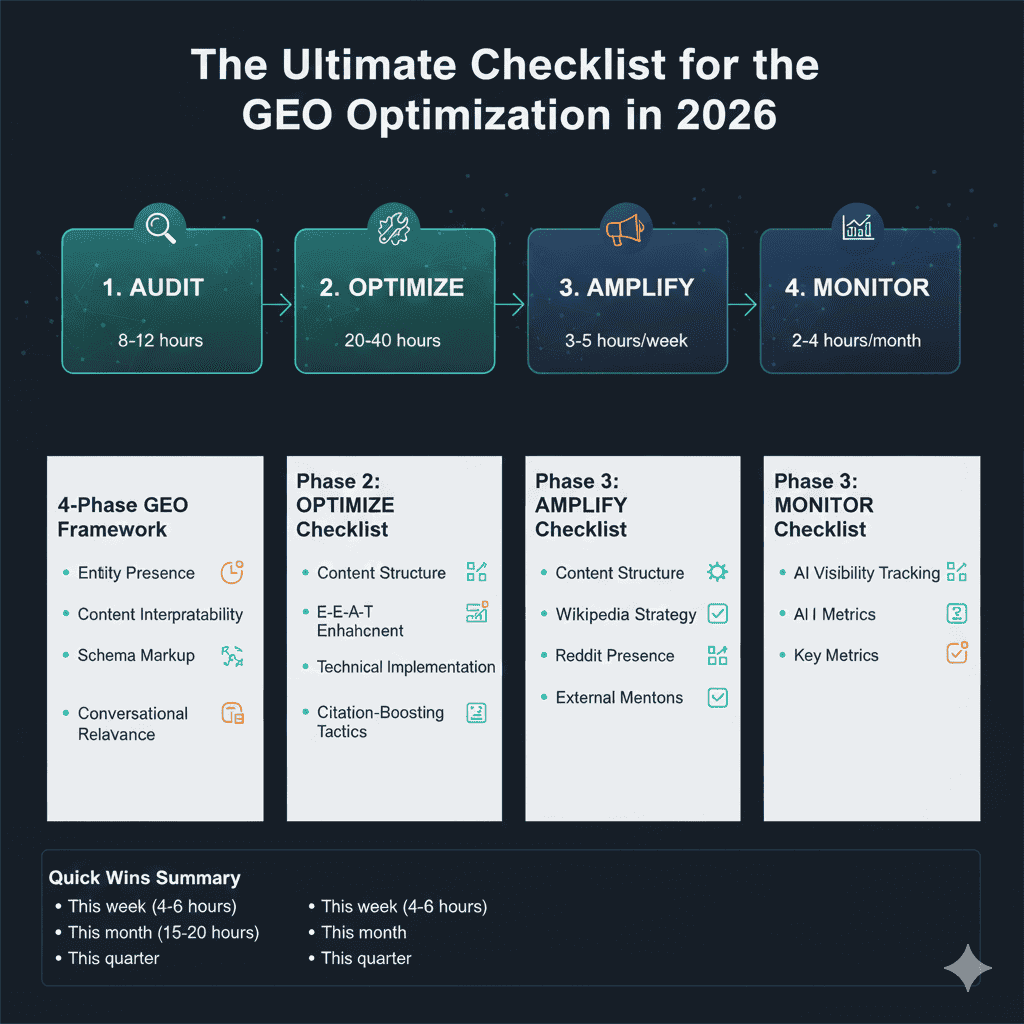
This checklist gives you a system: Four phases—AUDIT, OPTIMIZE, AMPLIFY, MONITOR.
What is GEO?
Generative Engine Optimization (GEO) is the practice of making your content discoverable and citable in AI-generated answers.
Key platforms:
ChatGPT (OpenAI) - 100+ million weekly users
Google AI Overviews - Appearing in 35%+ of US searches
Gemini (Google) - Integrated across Google products
Perplexity - Fast-growing AI search engine
Claude (Anthropic) - Popular among technical audiences
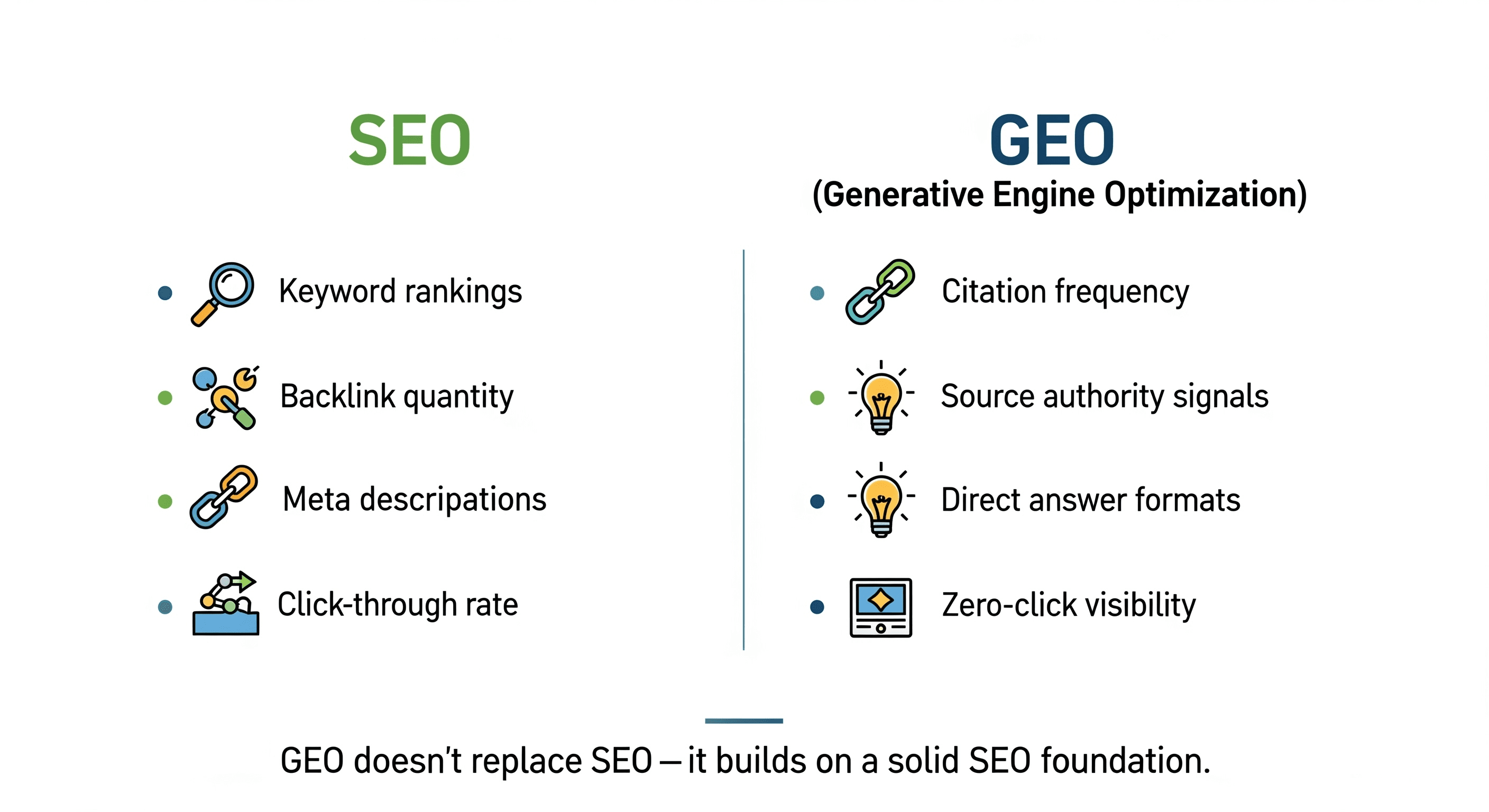
GEO vs. SEO
GEO vs. SEO
The 4-Phase GEO Framework
Phase 1: AUDIT (8-12 hours) - Assess your current state across four layers.
Phase 2: OPTIMIZE (20-40 hours) - Implement content, technical, and structural improvements.
Phase 3: AMPLIFY (3-5 hours/week) - Build authority beyond your website.
Phase 4: MONITOR (2-4 hours/month) - Track performance and iterate.
Phase 1: AUDIT Checklist
Layer 1: Entity Presence
Wikipedia presence (if qualifying for notability)
Organization schema on homepage
Key team members have LinkedIn profiles
Listed in industry directories (Crunchbase, G2, Product Hunt)
Google Knowledge Panel recognition
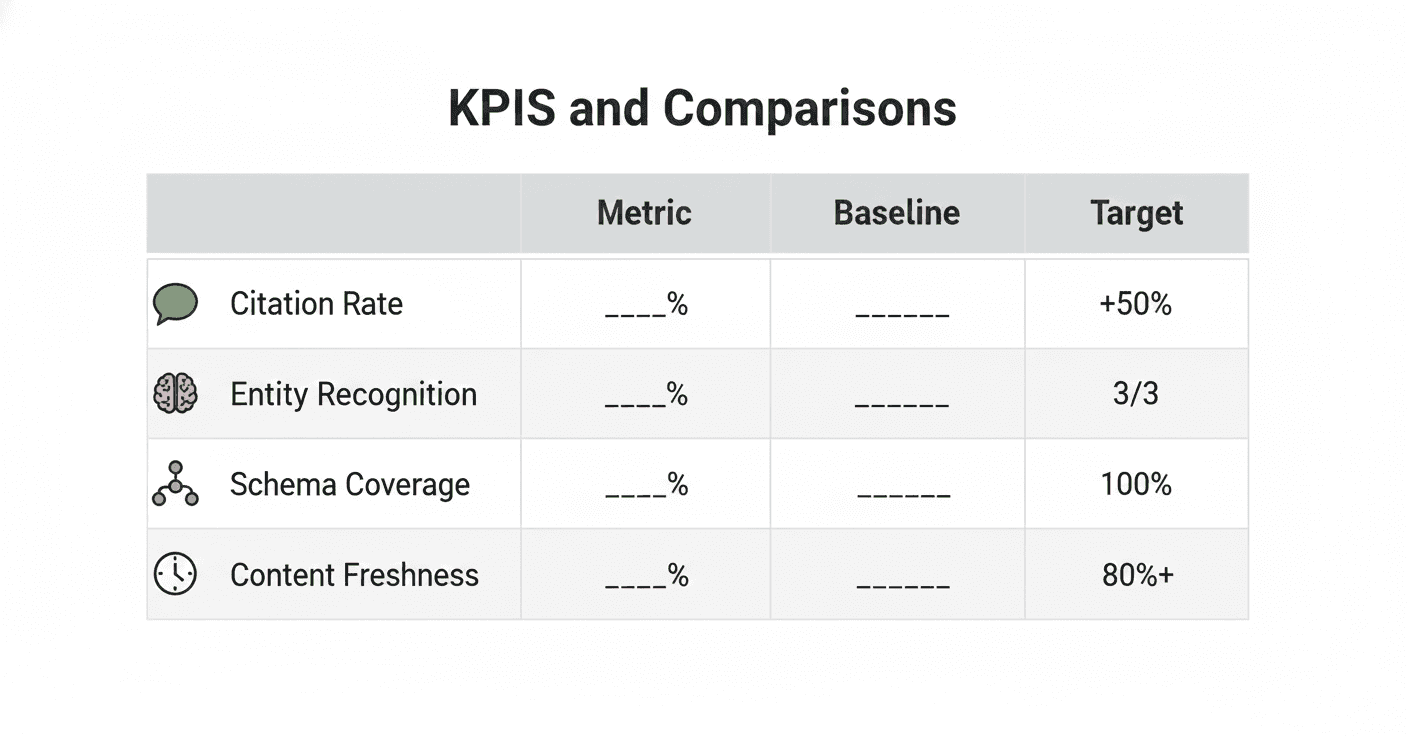
Test: Ask ChatGPT, Gemini, Perplexity: "What is [Your Company]?" Pass if 2/3 recognize you.
Layer 2: Content Interpretability
Clear heading hierarchy (one H1, H2s divide sections)
Short paragraphs (2-4 sentences max)
Key information in first 200 words
Direct answer format (answer before elaboration)
Technical jargon defined
Test: Flesch Reading Ease score above 50.
Layer 3: Schema Markup
Organization schema on homepage
Article schema on blog posts
FAQPage schema where applicable
Person schema for authors
BreadcrumbList schema
Test: Validate with Google's Rich Results Test.
Layer 4: Conversational Relevance
30-50 strategic query list created
Content matches natural language questions
FAQ sections on key pages
Comparison content ("X vs Y")
How-to and What-is content
Test: Calculate citation rate across AI platforms. Target: 15-20%+ baseline.
Phase 2: OPTIMIZE Checklist
A. Content Structure
Break paragraphs longer than 5 sentences
Add subheadings every 150-200 words
Implement direct answer format (answer first, details second)
Add "Key Takeaway" boxes and TL;DR summaries
Use questions as H2s where natural
B. E-E-A-T Enhancement
Experience:
First-person case studies with specific metrics
Process documentation ("Here's how we did it")
Original research content
Expertise:
Comprehensive author bios (100-150 words)
Author credentials and certifications displayed
Real bylines (not "The Team")
Authoritativeness:
5+ authoritative source citations per article
Expert quotes (increases citation by 32%)
Topic clusters with pillar content
Trustworthiness:
"Last updated" timestamps on articles
Every statistic sourced
Transparent disclosures
C. Technical Implementation
Essential Schema Types:
Organization Schema (Homepage) - Name, logo, URL, social profiles, contact
Article Schema (Blog Posts) - Headline, author, datePublished, dateModified
FAQPage Schema (FAQ Sections) - Question/Answer pairs under 100 words each
Person Schema (Author Pages) - Name, jobTitle, worksFor, credentials
Technical Foundation:
Page speed under 3 seconds
Core Web Vitals in "Good" range
Mobile-responsive design
HTTPS enabled site-wide
XML sitemap current
D. Citation-Boosting Tactics
Statistics (+33.9% citation visibility):
Minimum 3 statistics per 1,000 words
Every stat has a linked source
Create original data (surveys, analysis)
Expert Quotes (+32% citation visibility):
1-2 expert quotes per article
Full attribution (name, title, company)
Link to expert profile
Writing Quality (+30% citation rates):
Flesch Reading Ease 60-70
80%+ active voice
Average sentence length under 20 words
Phase 3: AMPLIFY Checklist
A. Wikipedia Strategy
Wikipedia comprises 47.9% of ChatGPT's top citations.
Assess notability per Wikipedia guidelines
If notable: Create/update page with neutral language
If not notable: Get mentioned on relevant category pages
B. Reddit Presence
Reddit is a top source for Perplexity and Google AI Overviews.
Identify 5-10 relevant subreddits
Build genuine karma (6+ months)
Share expertise without promotion
C. External Mentions
Guest posts on industry publications
Podcast appearances
Conference speaking
Contribute to industry research/reports
Phase 4: MONITOR Checklist
A. AI Visibility Tracking
Weekly monitoring (30 min):
Test 10-15 priority queries across ChatGPT, Gemini, Perplexity
Note: Are you cited? How prominently?
Track citation rate over time
Monthly deep dive (2-4 hours):
Full 50-query audit
Calculate citation rate by platform
Identify patterns (what content gets cited?)
B. Key Metrics
Metric Comparison Overview
Quick Wins Summary
This week (4-6 hours):
Add FAQ section + schema to homepage
Update top 5 articles with "Last updated" timestamps
Add 2-3 expert quotes to your most important article
This month (15-20 hours):
Complete 4-layer audit
Implement Organization + Article schema site-wide
Create 3-5 "What is" definition articles
Set up weekly AI citation tracking
This quarter:
Build Wikipedia presence (page or mentions)
Establish Reddit authority in 2-3 subreddits
Publish original research with citable data
The Bottom Line
GEO is not optional. By 2026, AI-generated answers will be the primary way users consume information.
The companies that win will:
Have strong entity presence across the web
Create content AI can easily parse and cite
Build authority through external mentions
Systematically track and improve citation rates
Start with Phase 1. Run the audit. Know where you stand. Then work through the checklist systematically.
The AI revolution in search is happening. This checklist ensures you're part of it.

Peter F.
GEO Strategist
Ready to Optimize for AI Search?
Join thousands of marketers who are already using LLMScout to track and improve their performance in AI search results.
Get Early Access