Content Clusters Explained: The Strategy That Actually Works
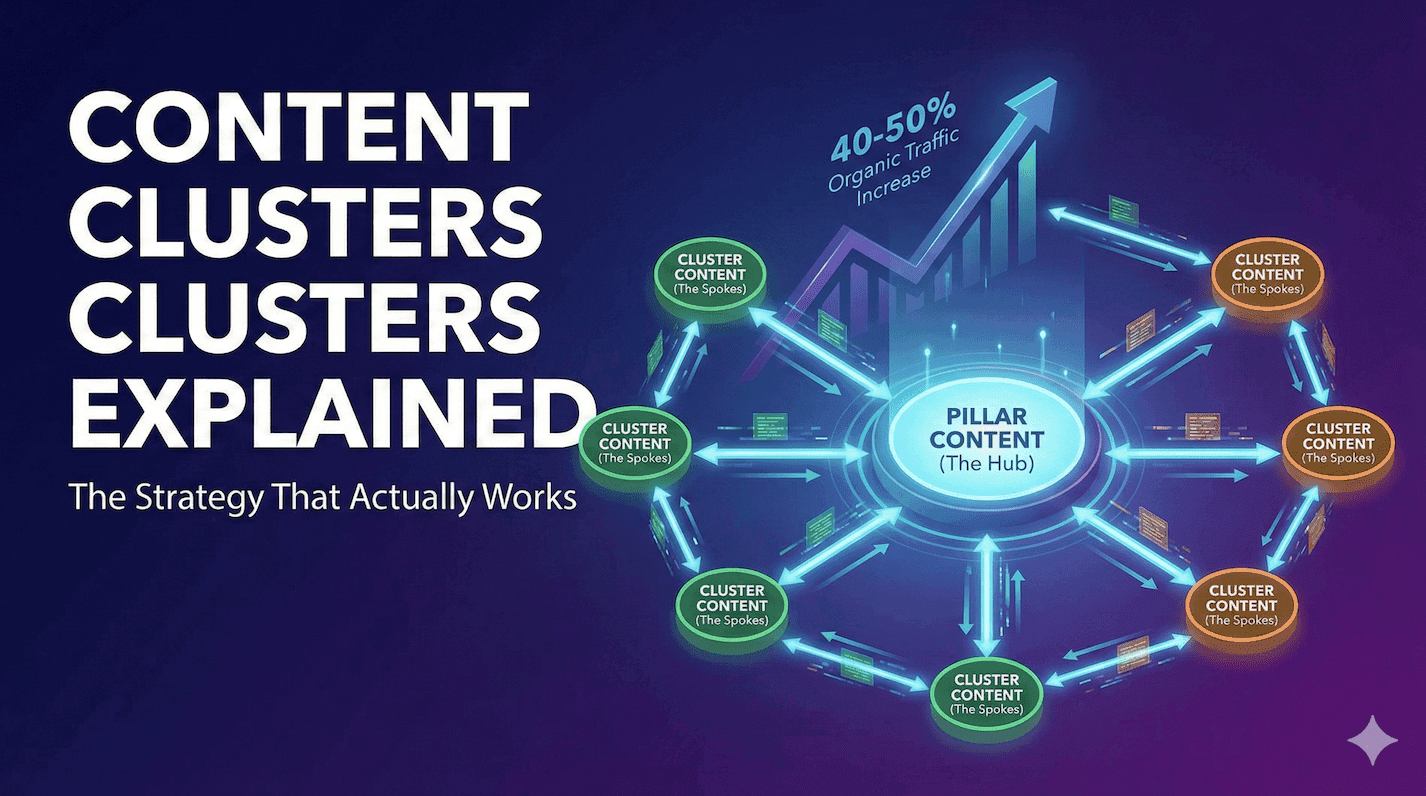
Content clusters transform scattered blog posts into an organized system that builds topical authority. Sites using this hub-and-spoke strategy see 40-50% organic traffic increases within six months. This guide shows you exactly how to build content clusters that work, with real examples and a step-by-step process you can start this week.
Content Clusters Explained
Content Clusters Explained
Content Clusters Explained: The Strategy That Actually Works
Most content strategies fail because they treat every article as a standalone piece. Topics overlap randomly. Your site becomes a collection of disconnected pages competing against each other.
Content clusters solve this problem. Sites using this strategy see organic traffic increases of 40-50% within six months. Internal link equity flows efficiently. Google understands your topical authority.
What is a Content Cluster?
A content cluster is a collection of interlinked articles organized around one central topic. Think of it as a hub-and-spoke model:
Hub (Pillar Content): Comprehensive guide covering a broad topic (3,000-5,000 words)
Spokes (Cluster Content): Deep dives into specific subtopics, all linking back to the hub
Example:
Pillar Page: "Complete Guide to Email Marketing" (5,000 words)
Cluster Content:
How to Build an Email List from Scratch
Email Segmentation Strategies That Increase Open Rates
A/B Testing Your Email Campaigns
Email Automation Workflows for E-commerce
GDPR Compliance for Email Marketing
This structure tells Google: "We're an authority on this entire topic, not just one aspect."
Why Content Clusters Work (The Data)
HubSpot pioneered content clusters in 2017. After implementing the strategy:
40% increase in organic traffic to pillar pages
Improved rankings for cluster content
Lower bounce rates, longer session duration
Terakeet analyzed 64,000 domains and found that sites with strong topical authority ranked for 15% more keywords than competitors.
Google's Shift to Topic-Based Rankings
Google's algorithm evolved from keyword matching to understanding topics semantically. When your content is clustered, Google sees:
Comprehensive coverage (expertise signal)
Clear content organization (user experience signal)
Strong internal linking (authority signal)
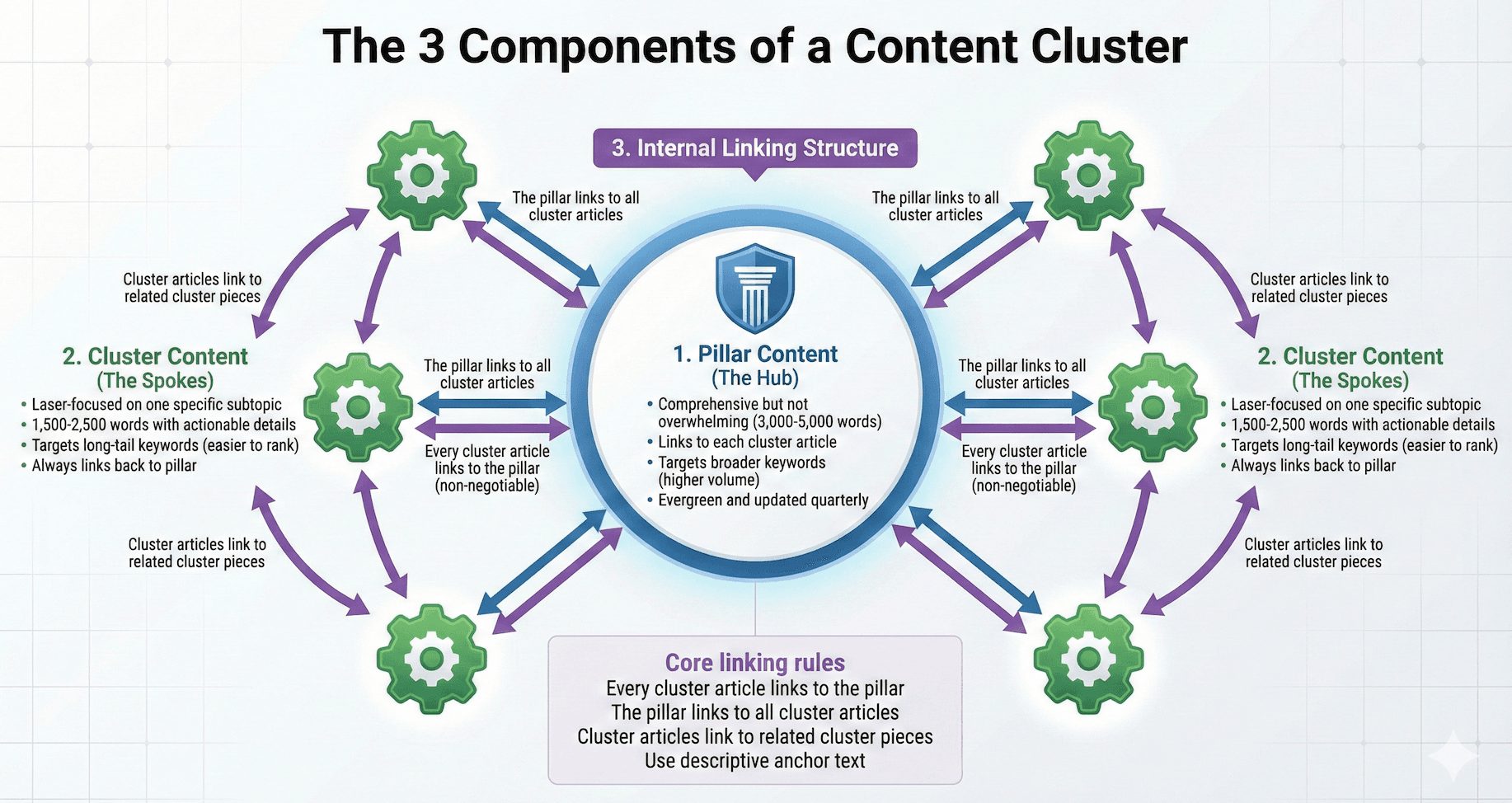
The 3 Components of a Content Cluster
Components of Content Cluster
1. Pillar Content (The Hub)
Comprehensive but not overwhelming (3,000-5,000 words)
Links to each cluster article
Targets broader keywords (higher volume)
Evergreen and updated quarterly
2. Cluster Content (The Spokes)
Laser-focused on one specific subtopic
1,500-2,500 words with actionable details
Targets long-tail keywords (easier to rank)
Always links back to pillar
3. Internal Linking Structure
Core linking rules:
Every cluster article links to the pillar (non-negotiable)
The pillar links to all cluster articles
Cluster articles link to related cluster pieces
Use descriptive anchor text
How to Build Your First Content Cluster
Step 1: Choose Your Pillar Topic
Criteria:
Business relevance (connects to your product/service)
Search volume (500+ monthly searches)
Subtopic potential (can you generate 8-12 cluster articles?)
Expertise available
Step 2: Research and Map Your Cluster
Use these sources to find subtopics:
Keyword tools (Ahrefs, Semrush, AnswerThePublic)
Competitor content analysis
Google's People Also Ask
Customer questions from support/sales
Create a spreadsheet: Pillar topic | Cluster article topics | Target keywords | Search volume | Priority
Step 3: Create the Pillar First
Pillar page structure:
Introduction (what, why, what you'll learn)
Core sections (6-10 major topics)
Cluster callouts (link to deep dives)
Examples and FAQ section
Publish the pillar first, then add cluster links as you create them.
Step 4: Build Cluster Content Systematically
Start with high-priority articles
Publish 1-2 per week consistently
Link to pillar in every article
Update pillar with each new cluster article
Step 5: Monitor and Iterate
Track:
Pillar page traffic and rankings
Cumulative cluster traffic
Internal click-through rates
Conversions by traffic source
Quarterly: Update statistics, add new cluster articles, refresh underperformers.
Real Content Cluster Examples
HubSpot: Marketing Automation Cluster
Pillar: "Marketing Automation: A Beginner's Guide"
Cluster: Email automation, lead scoring, CRM integration, workflows, platforms, KPIs
Result: Dominates rankings for "marketing automation" and hundreds of long-tail keywords.
ConvertKit: Small Business Example
Pillar: "Email Marketing for Creators" (2,500 words)
Cluster: 6 articles published over 6 weeks
Result: 65% traffic increase to pillar after cluster completion.
5 Common Mistakes to Avoid
Topics too narrow - If you can't generate 8+ cluster articles, expand the topic
Inconsistent internal linking - Without consistent links, you don't have a cluster
Publishing everything at once - Publish pillar first, then 1-2 cluster articles per week
Ignoring existing content - Audit and reorganize existing articles into clusters
Thin cluster content - Each article needs 1,500+ words of value
Content Clusters and AI Search
AI platforms (ChatGPT, Perplexity, Claude) look for comprehensive, authoritative sources. Content clusters signal exactly that.
Optimizing clusters for AI:
Factual, specific content (AI favors verifiable info)
Clear headers stating what each section covers
Data, examples, step-by-step instructions
Regular updates (AI prioritizes recency)
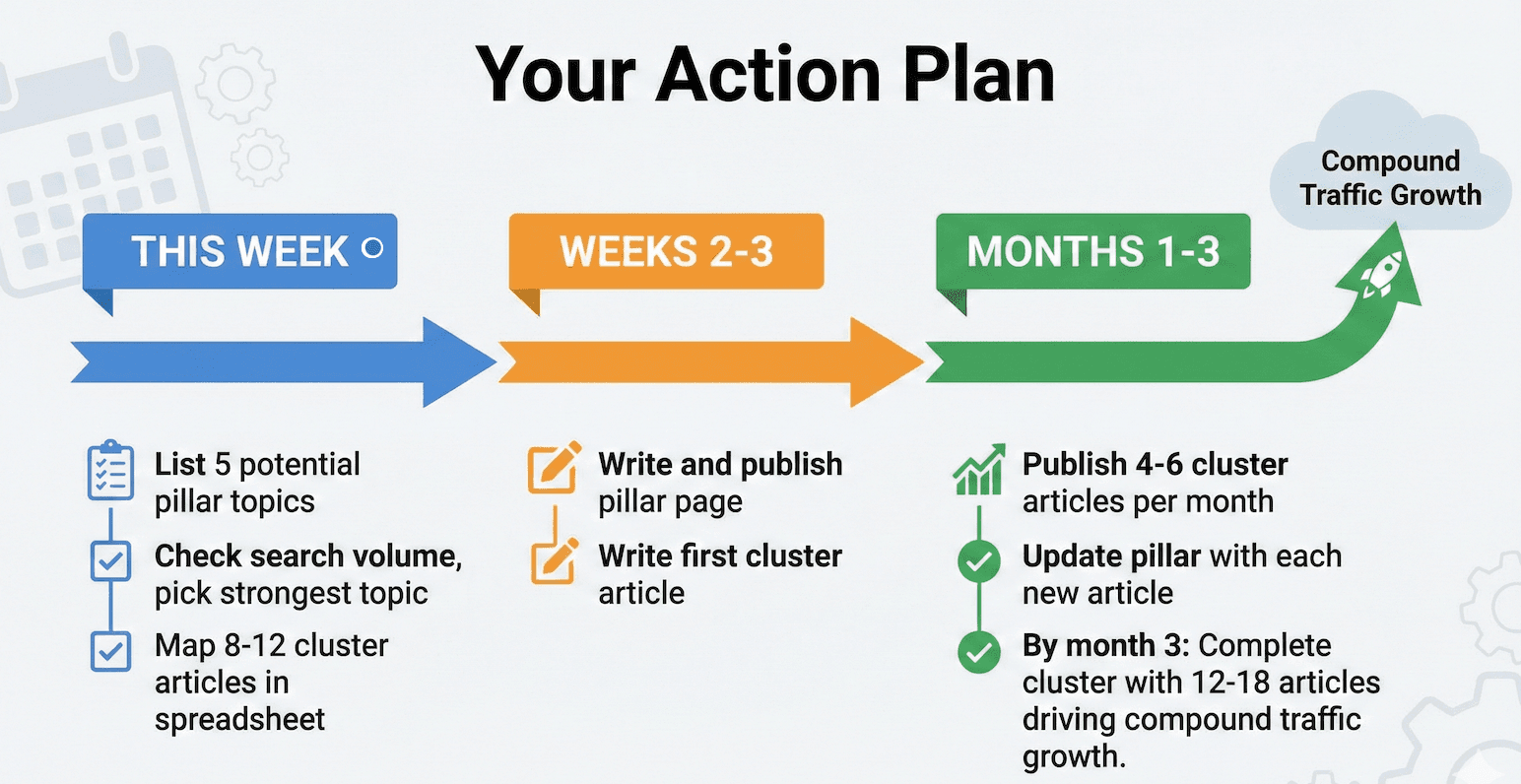
Your Action Plan
Action Plan for Traffic Growth
This Week:
List 5 potential pillar topics
Check search volume, pick strongest topic
Map 8-12 cluster articles in spreadsheet
Weeks 2-3:
Write and publish pillar page
Write first cluster article
Months 1-3:
Publish 4-6 cluster articles per month
Update pillar with each new article
By month 3: Complete cluster with 12-18 articles driving compound traffic growth.
The Bottom Line
Content clusters aren't a hack. They're how content strategy should work: organized, intentional, and built for long-term authority.
The companies winning with SEO in 2026 aren't publishing more content—they're publishing better-organized content.
Start with one cluster. Map it this week. In six months, you'll have a traffic-driving machine that compounds with every article you add.

Peter Frank
Founder
Ready to Optimize for AI Search?
Join thousands of marketers who are already using LLMScout to track and improve their performance in AI search results.
Get Early Access